
Last updated September 20, 2026
Full 25-point door and opener safety check with every visit - springs, cables, rollers, tracks, and your LiftMaster or Chamberlain opener included
You get a price before we start. It does not change when the truck arrives.
 Before
 After
After Before
 After
After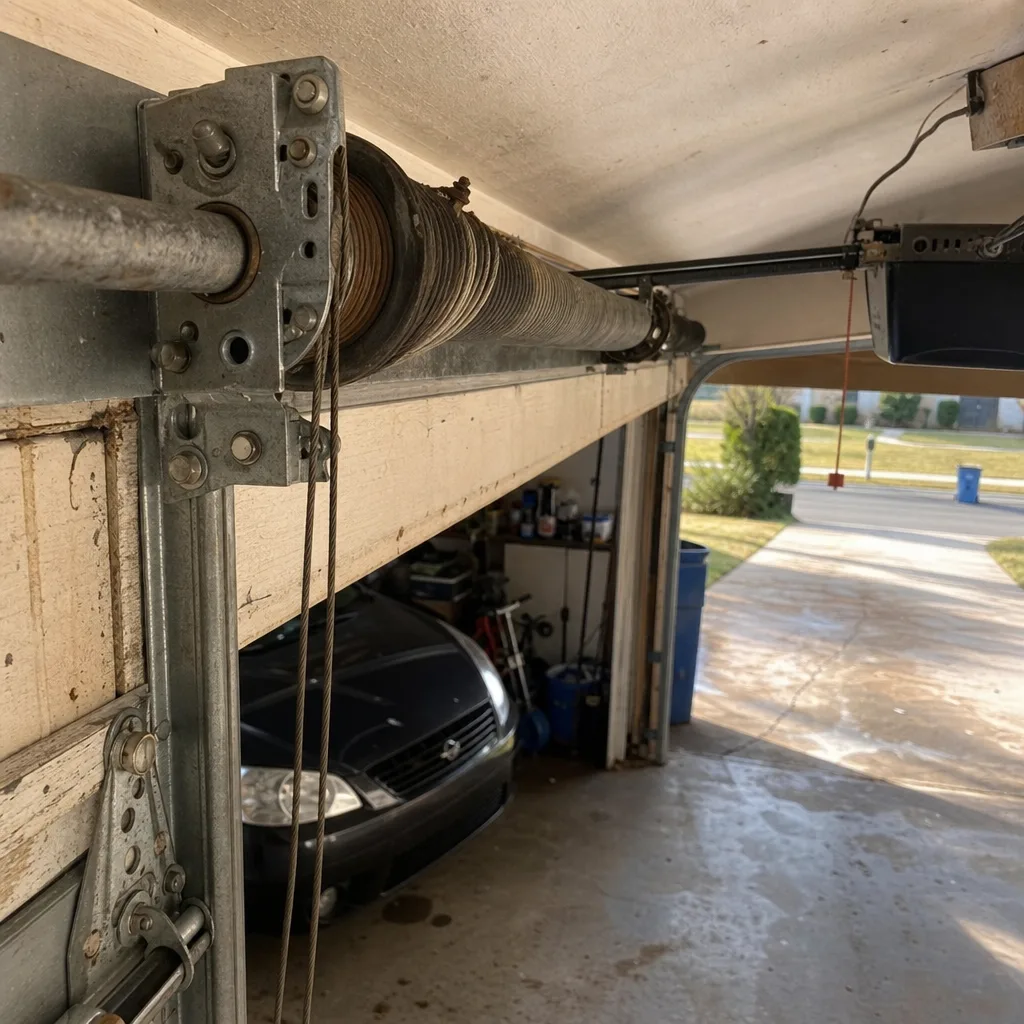 Before
 After
AfterThe Complete Guide to Garage Door in Lakeland
Most garage door manufacturers write their warranty booklets in Ohio or Michigan, where a spring might cycle 10,000 times before failing. In Lakeland, with humidity averaging 74% year-round and UV indexes peaking above 11 in summer, that same spring is working against conditions the warranty never accounted for. This guide explains what actually happens to a garage door in Polk County’s climate, what the components are called, what things cost, and how to read a quote without getting taken. For more guides & resources on keeping your garage door running, see our blog. By the end, you’ll know more about your garage door than the average person who sells them.
Quick Answer
A garage door in Lakeland is a mechanical system of springs, cables, tracks, and an operator that wears out faster than national averages because of humidity and UV exposure. Homeowners in Lakeland should expect torsion springs to last 7-9 years instead of the 10-12 quoted nationally, budget $180-$340 for a spring replacement, and always get a written price before any work begins. The best defense against overpaying is understanding what each component does and what a legitimate quote should look like. See our Garage Door Cost Breakdown: The Lakeland Homeowner’s Reference for 2026 for detailed pricing.
Table of Contents
- The Mechanical Components of a Garage Door System
- How Lakeland’s Climate Shortens Garage Door Lifespans
- Material Comparison: Steel, Aluminum, Fiberglass, and Wood Composite in Lakeland
- What Garage Door Service Actually Costs in Lakeland
- How to Read a Garage Door Quote Line-by-Line
- A Lakeland Homeowner’s Maintenance Schedule
- Signs Your Garage Door Needs Attention
BeforeAfterThe Mechanical Components of a Garage Door System
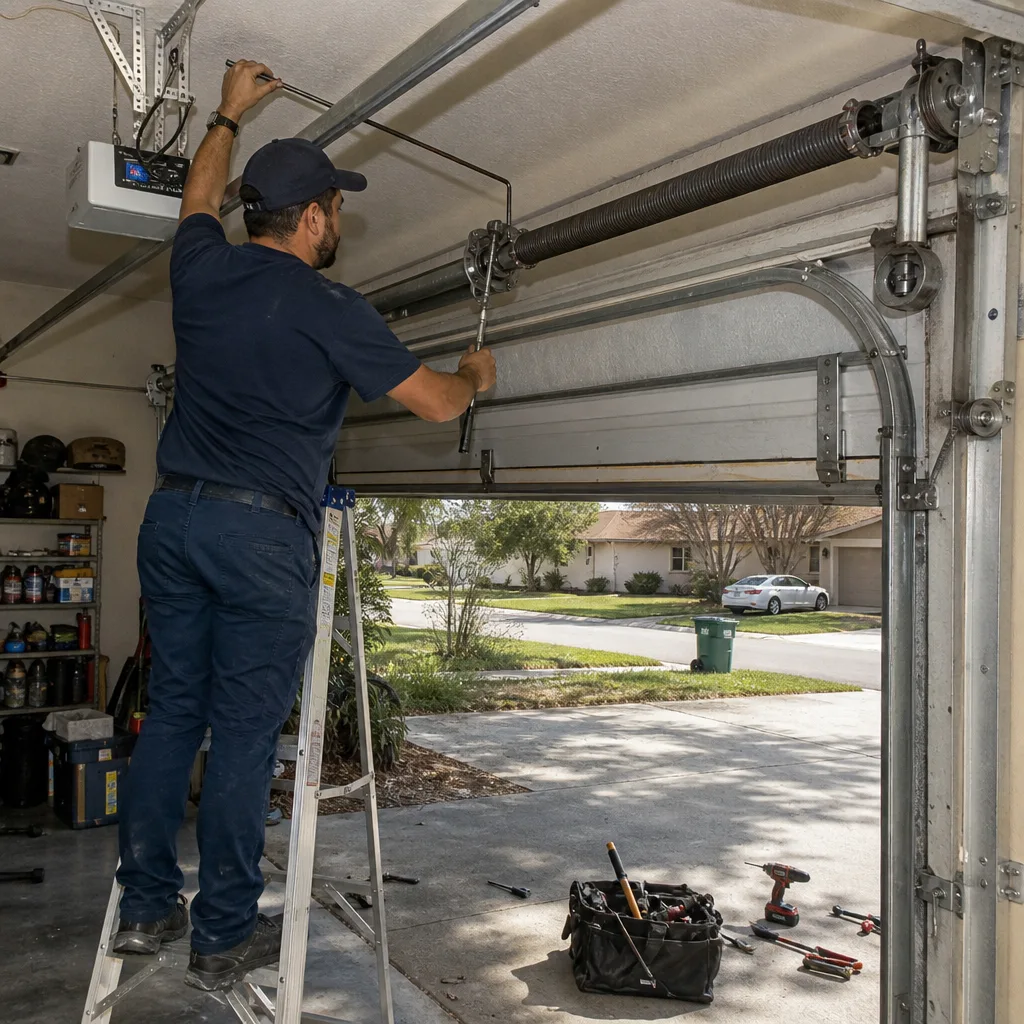
Before you can have an informed conversation with any technician, you need to know what the parts are called. Here’s the system, named and explained in plain English.
The Torsion Spring
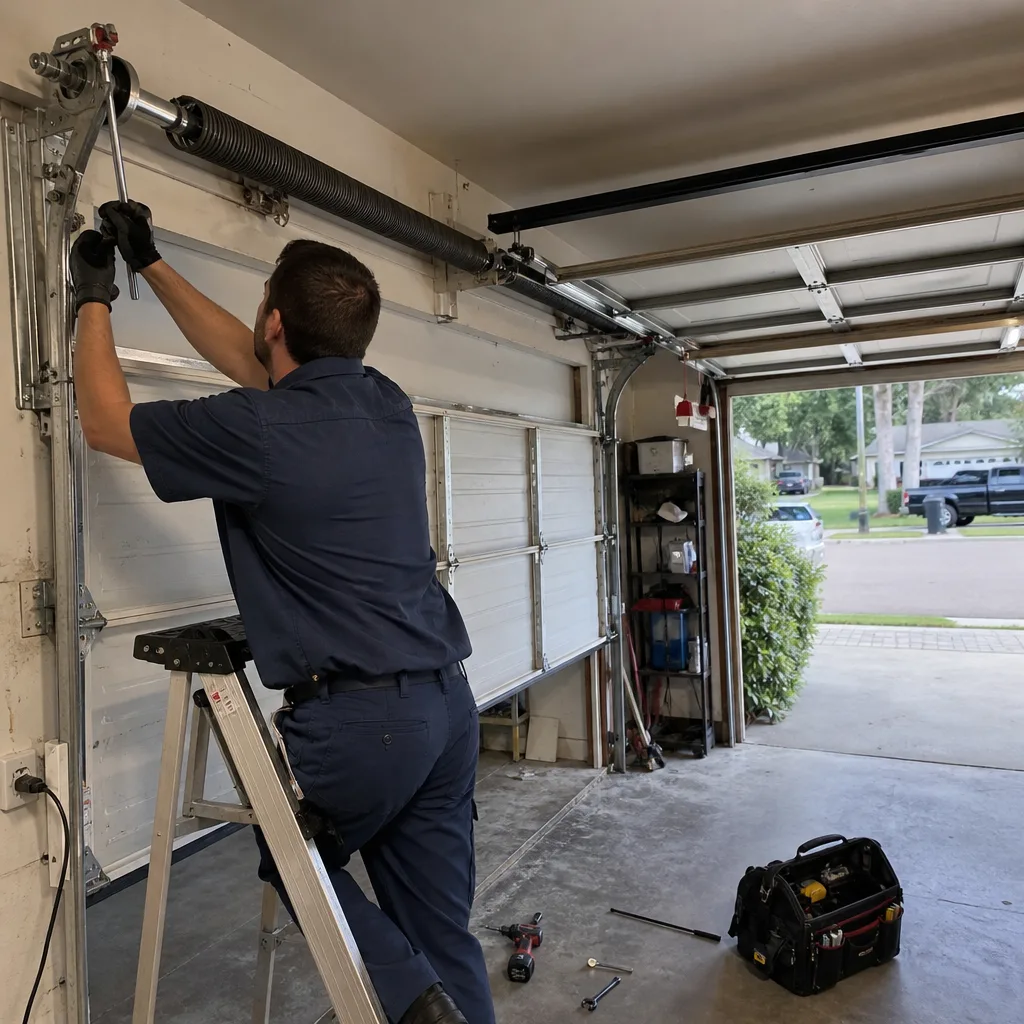
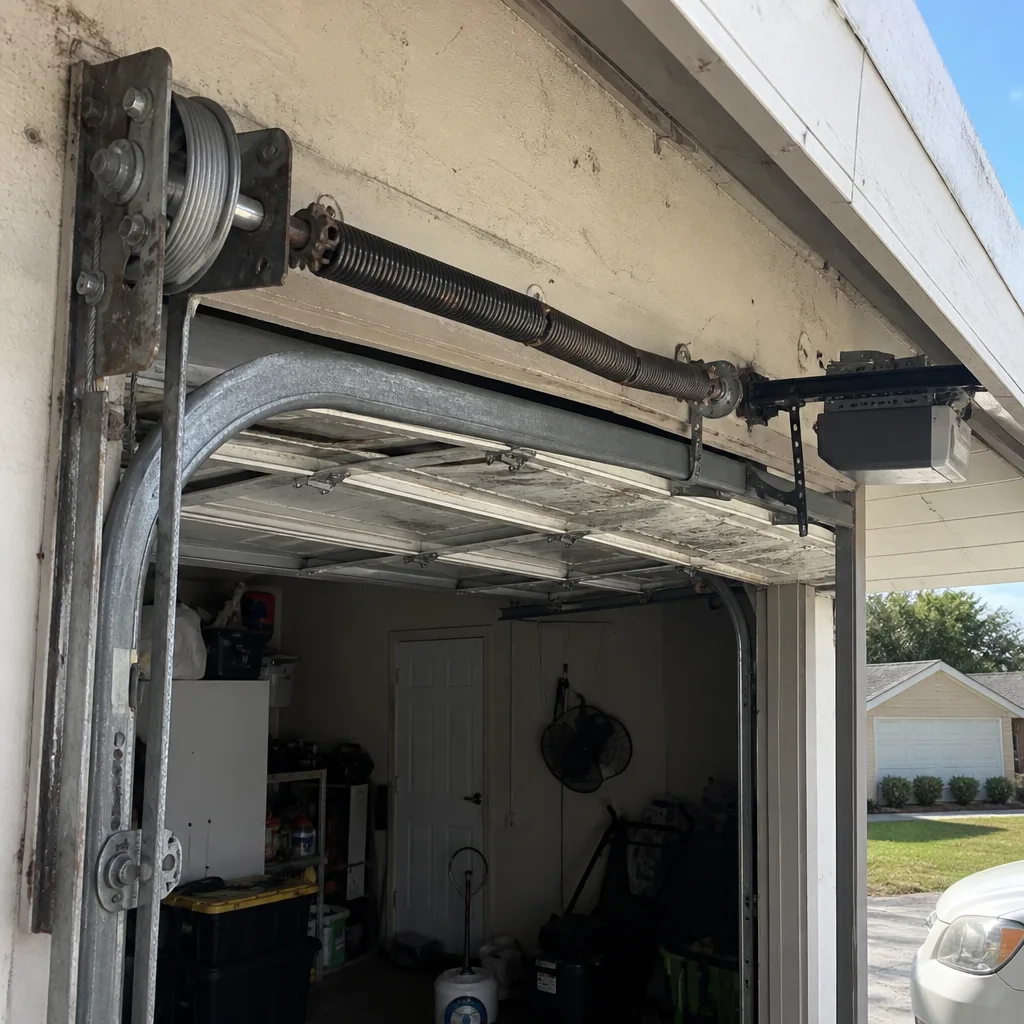
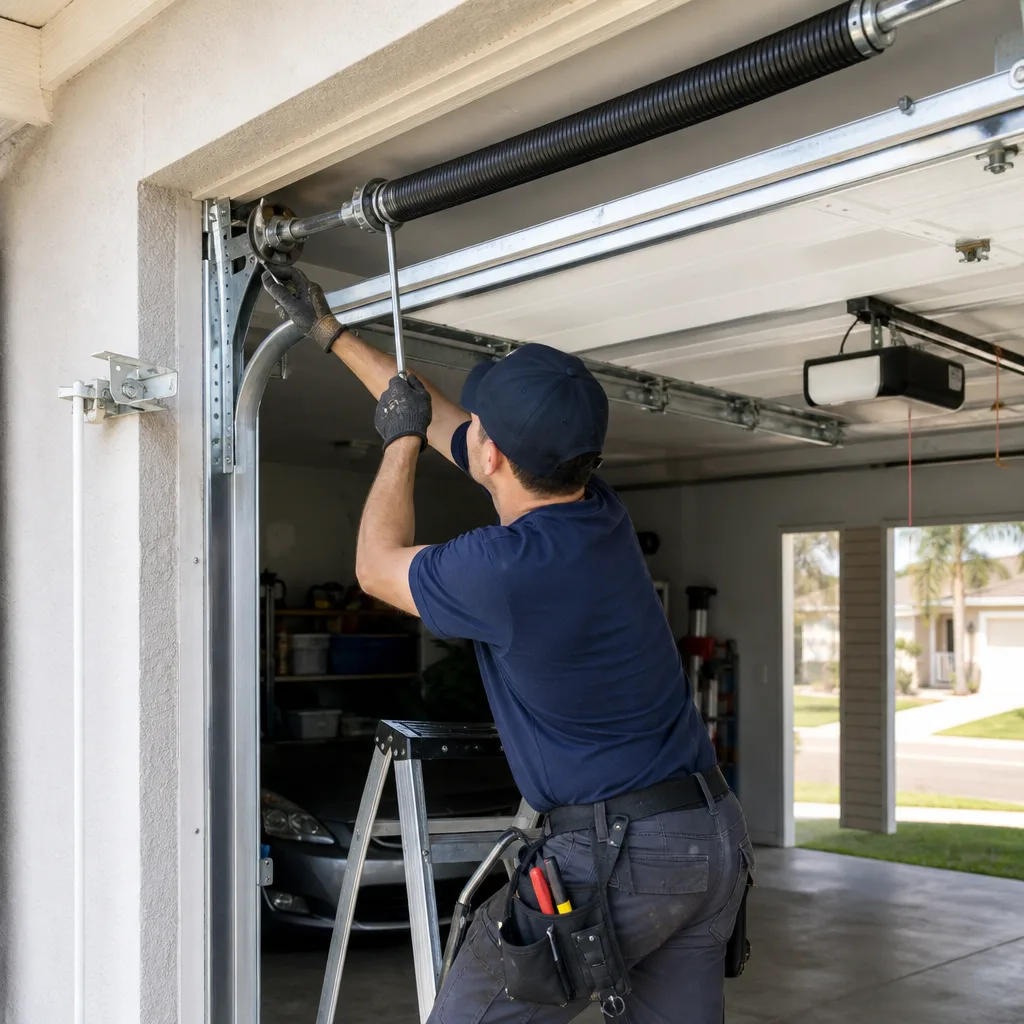
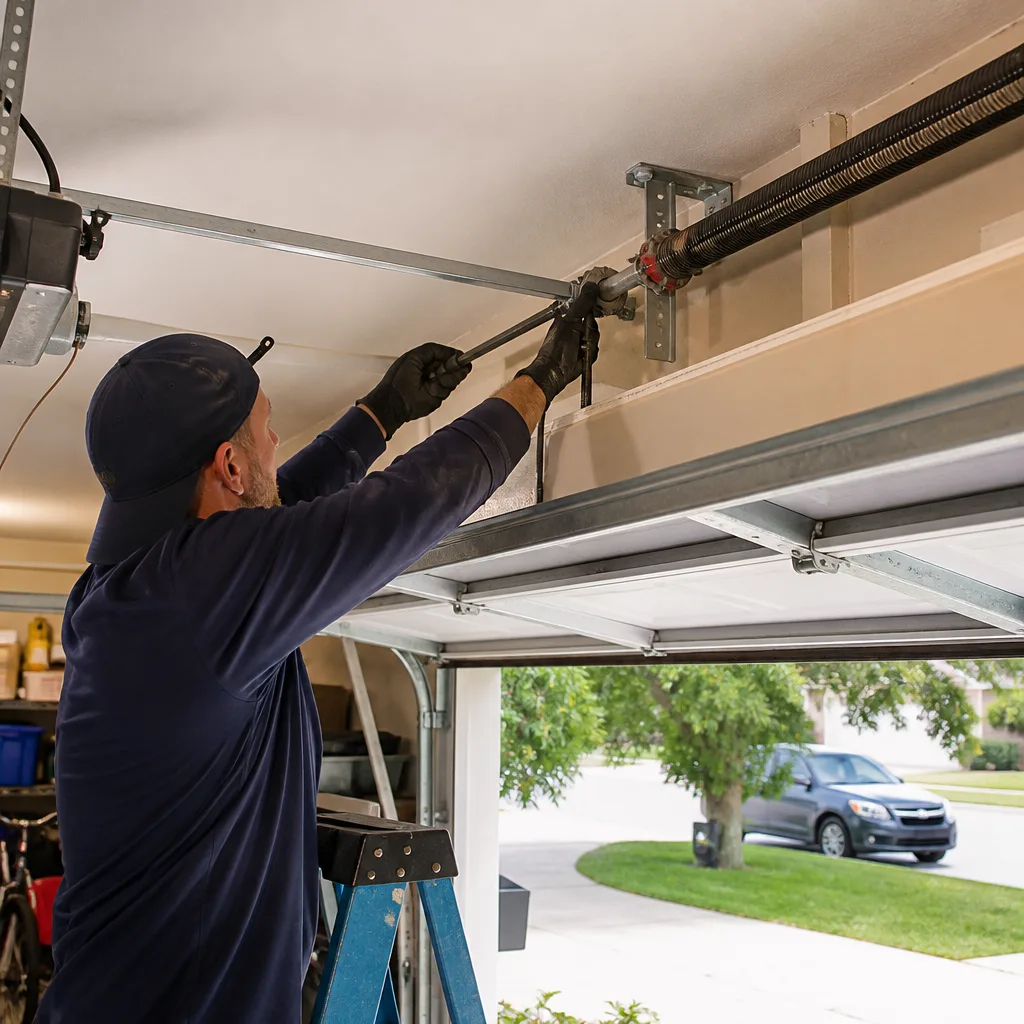
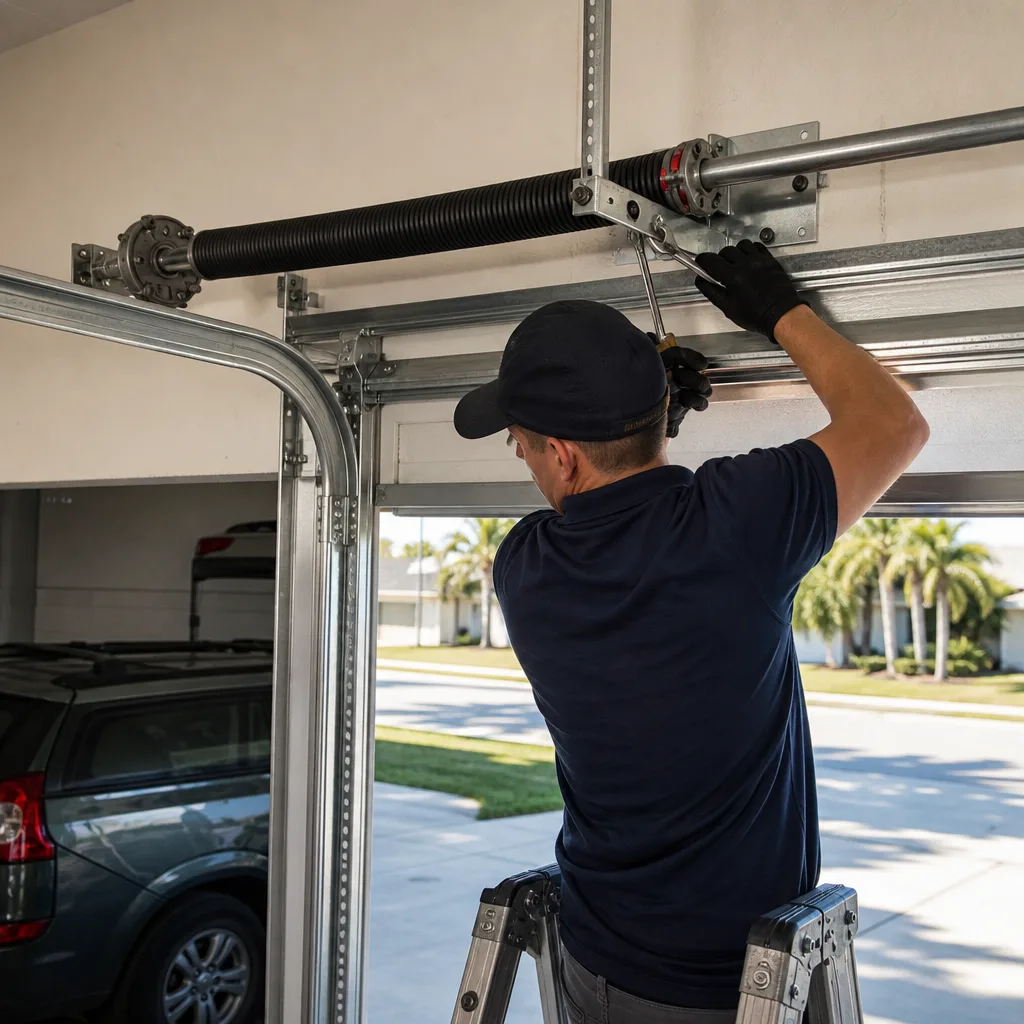
The torsion spring is a coiled steel spring mounted on a metal shaft above the door opening. It counterbalances the weight of the door, which for a standard 16-foot steel door in Lakeland is roughly 160 to 220 pounds. When you see a technician point “up there” and say the spring failed, this is what they’re pointing at. In our experience across Lakeland, when a torsion spring breaks, it’s almost always a clean break at the coil, and it sounds like a gunshot from inside the house. These springs are rated by cycle life: 10,000 cycles is standard, 20,000 is high-cycle. If a spring on your door is older than seven years and original to the home, it’s on borrowed time in this climate.
Safety note: Torsion springs are under high tension and can cause serious injury if mishandled. Never attempt to remove or adjust one without training and proper winding bars. This is one repair where calling a professional isn’t convenience, it’s the only sensible option.
The Cables
Cables run along both sides of the door, connecting the bottom brackets to the drums up near the spring shaft. They carry the door’s weight when it moves. In Lakeland, the main enemy of cables is not wear, it is corrosion. Humidity gets into the cable strands, and over time rust weakens them until they fray or snap. A frayed cable is visible if you know what you’re looking for: tiny broken wires poking out from the main cable body. If you see that, stop using the door and call someone. A cable failure while the door is moving can drop the door hard enough to damage the track or, in the worst case, injure someone.
The Drums
Drums are the grooved spools at each end of the torsion spring shaft that the cables wind around. If a drum is wearing, you’ll usually see uneven cable winding or hear a grinding noise from the shaft area. Drums rarely fail on their own. They fail because a cable snapped first or because a spring was replaced incorrectly.
The Bottom Bracket
The bottom brackets hold the cables to the bottom corners of the door. These brackets are under constant load. In Lakeland, the hardware on salt-adjacent or high-humidity homes can corrode faster than the rest of the assembly. A failed bottom bracket often presents as a door that suddenly jerks to one side when opening.
The Operator (Opener)
The operator is the motorized unit that moves the door. In modern homes, it’s usually a belt-drive or chain-drive unit from LiftMaster, Chamberlain, or Genie. The operator has a logic board inside, which is the circuit board that tells the motor what to do. When a Lakeland homeowner says “the opener just stopped working,” the logic board is the first thing a good technician checks, because power surges from summer thunderstorms in Central Florida are a common cause of board failure. The trolley carriage is the piece that slides along the rail and pulls or pushes the door. The limit switch tells the opener where “up” ends and “down” begins.
For a deeper look at how all these pieces work together, see our Garage Door Repair in Lakeland page, which walks through the diagnostic process step by step.
How Lakeland’s Climate Shortens Garage Door Lifespans
National lifespan figures for garage door components assume a temperate climate. A homeowner in Michigan can reasonably expect a torsion spring to last 10 to 12 years. A homeowner in Lakeland should plan on 7 to 9. Here’s why the math is different in Polk County.
Humidity Above 74% Year-Round
Lakeland’s average relative humidity sits above 74% throughout the year. That means unprotected steel is constantly exposed to moisture, even when it’s not raining. Cables rust. Springs develop pitting, which is the start of metal fatigue. Bottom brackets corrode at the bolt points. The hardware on a Lakeland garage door is essentially living in a mild salt-spray chamber year-round, minus the salt. If your garage is not climate-controlled, and most in Lakeland are not, the air inside is the same humid air from outside.
UV Index Above 11 in Summer
Lakeland regularly sees peak UV indexes above 11 in June, July, and August. That level of UV exposure degrades paint, weatherstripping, and most importantly, the bottom seal and the vinyl trim around the door opening. A bottom seal that would last five years in a shaded northern garage might crack and shrink in three Lakeland summers. When the seal fails, water gets under the door during the afternoon downpours that define Florida’s wet season, and then you have not just a worn seal but potential water damage to whatever you store on the garage floor.
Thunderstorm Power Surges
Central Florida is the lightning capital of the United States. When a thunderstorm knocks out power or sends a surge through the lines, garage door opener logic boards absorb the hit. A surge protector on the opener’s outlet helps, but most Lakeland homes were built before anyone thought to install one. Board failures after storms are one of the most common calls we get in the summer months. And it’s not always a full failure; sometimes it’s a partially fried board that works intermittently, which is harder to diagnose and more likely to get misdiagnosed by someone in a hurry.
What This Means for Your Budget
The practical takeaway is simple: a Lakeland homeowner should plan for spring replacement every 7 to 9 years, cable inspection annually, and bottom seal replacement every 2 to 3 years. If you bought your home in Lakeland between 2015 and 2025 and have not touched the garage door since closing, you are statistically close to a component failure. Understanding that gap between what the manufacturer quotes and what Lakeland actually delivers is the single biggest advantage an informed homeowner has.
Material Comparison: Steel, Aluminum, Fiberglass, and Wood Composite in Lakeland
National comparison charts for garage door materials are nearly useless for Lakeland buyers. A material that performs fine in Ohio might fail in five years of Polk County sun and humidity. Here’s how each material actually holds up here.
Steel
Steel is the most common garage door material in Lakeland, and for good reason: it’s the best balance of cost and durability. A 25-gauge steel door is the entry-level option; 24-gauge is the standard; 24-gauge with insulation is what most Lakeland homeowners should choose. Steel doors resist impact well and take paint well. The weakness in this climate is at the cut edges and the hardware attachment points, where the factory coating is thin. On a standard steel door, expect the bottom panel to show rust first, especially on the inside face where humidity sits against the metal overnight. Regular washing and a quality automotive wax on the exterior panels go further in Lakeland than most people think.
Aluminum
Aluminum doors are lighter and naturally rust-resistant, which would seem to make them ideal for humid Central Florida. The trade-off is dent resistance. An aluminum door will show hail damage from a Florida afternoon storm that a steel door shrugs off. Aluminum is also the material of choice for full-view doors, the ones with large glass panels. If you have an aluminum full-view door in Lakeland and it faces west, the glass panels are doing serious work during summer. That heat load inside the garage is real, and an uninsulated glass door on a west-facing garage will measure over 100 degrees on the inside panel at 4 p.m. in July.
Fiberglass
Fiberglass doors handle humidity exceptionally well. They’re also the lightest option, which reduces wear on springs and cables. But fiberglass has a UV problem. In Lakeland’s summer sun, the gel coat on a fiberglass door will chalk and fade noticeably within five years. And fiberglass panels crack on impact more readily than steel or aluminum. We’ve replaced fiberglass doors in Lakeland that were still mechanically functional but looked so sun-faded the homeowner simply couldn’t stand it. If your garage faces south or west, think twice about fiberglass.
Wood Composite and Solid Wood
Solid wood doors look beautiful and are the most expensive option in this market. They are also the highest-maintenance choice for a humid climate. In Lakeland, a wooden door needs annual repainting or resealing. Miss one year and the bottom rail starts to absorb moisture, which causes warping. Once a wood door warps, it does not unwarp; you replace the panel or the whole door. A wood composite door (engineered wood over a foam core) is more stable than solid wood and less expensive, but still requires faithful annual sealing. If you love the wood look and will actually maintain it, fine. If you know yourself better than that, choose steel with a wood-grain finish and move on.
What We Recommend for Lakeland Buyers
- Best all-around value: 24-gauge insulated steel, factory-finished. Holds up to humidity, acceptable dent resistance, highest insulation value for the dollar.
- Best for full sun exposure: Steel with a factory paint finish. Avoid fiberglass on south- or west-facing doors.
- Best for low maintenance: Aluminum, if you can live with the dent risk and have a shaded or east-facing garage.
- Best if budget doesn’t matter and you love wood: Wood composite, with a commitment to annual sealing.
For a full breakdown of the installation options, see Garage Door Installation in Lakeland.
What Garage Door Service Actually Costs in Lakeland
Here’s the part where most contractors get vague. We’ll be specific, because the whole point of our operation since 2015 has been a written price before any work starts, and that means we have to talk about money openly.
Typical Service Ranges in Lakeland, 2025
| Service | Typical Range in Lakeland | Notes |
|---|---|---|
| Torsion spring replacement (single) | $180-$280 | Includes part and labor. High-cycle springs run higher. |
| Torsion spring replacement (pair) | $300-$500 | Recommended when both springs are the same age. |
| Cable replacement (both sides) | $150-$250 | Usually done with spring work. |
| Bottom seal replacement | $80-$150 | Material cost is low; you’re paying for the trip and the hour. |
| Opener repair (logic board) | $120-$220 | Depends on brand. Chamberlain and LiftMaster boards are common. |
| Full opener replacement | $350-$650 | Installed. Belt drive runs the top of the range. |
| Full door replacement (16×7 steel) | $1,200-$2,400 | Insulated steel, installed. Wood composite runs higher. |
These are real ranges for the Lakeland market. If a quote lands far below these numbers, the technician is probably planning to find “additional issues” once the door is apart. If it lands far above, you’re being charged a replacement cost for what should be a repair. The price a contractor quotes before touching anything is the single clearest signal of whether they operate on margin or on trust. A contractor who operates on margin has no incentive to write anything down. A contractor who operates on trust wants the number in writing because they know they’ll stand behind it.
Every job we do at Servo Garage Doors Lakeland home starts with a flat, written price and a written scope of work. That’s Clause 1 of The Haven Standard, the operating standard we work under. It means the number you approve is the number you pay, and if the technician finds something else once the door is open, the new quote is written before any additional work proceeds.
How to Read a Garage Door Quote Line-by-Line
Most garage door quotes are deliberately vague. Here’s how to read one and identify which charges are legitimate, which are padding, and which are red flags.
Step 1: Look for the Parts Let’s identify what you’re buying.
- The spring line item should specify the spring. A legitimate quote for a spring replacement says something like “Torsion spring, 0.250 wire, pair, high-cycle (20,000 cycles).” A vague quote says “spring replacement” with a single number. The vague quote is an invitation to install the cheapest spring on the truck and charge the high-cycle price.
- The parts should have part numbers or at minimum specifications. Brand names matter less than specs. A 0.225-inch wire spring is not the same as a 0.250-inch wire spring, even if both fit your door. The thin one is cheaper and fails sooner.
- The labor should be a separate line item. If parts and labor are bundled into one number, you cannot tell what you’re paying for either. That’s intentional on the contractor’s part.
Step 2: Look for What’s Not There
- No written scope of work. If the quote says “fix garage door” and a price, that’s not a quote, that’s a placeholder. A written scope says: “Replace both torsion springs with high-cycle springs, inspect cables and drums, lubricate all moving parts, adjust opener travel limits.” Each item should be listed.
- No warranty terms. What’s covered, for how long, and in writing. A verbal “we’ll take care of you” is not a warranty. We back every repair with our 365-Day Done Right Promise, which is exactly what it sounds like: if a repair isn’t right within a year, we make it right. That promise is in writing, per Clause 4 of The Haven Standard.
- No mention of documentation. This is the one that separates serious operators from everyone else. The founding rule of our company, since our first job in 2015, is that the customer sees the failed part before we quote a replacement. That means photos. On every job, you receive a documented photo record of what we found and what we did. If your quote doesn’t mention anything like this, you’re buying blind.
Step 3: Count the Line Items
A legitimate quote for, say, a spring replacement typically has 3 to 5 line items: the spring or springs, the labor, any small hardware (bearing, cable if needed), and a service or trip charge if one applies. A quote with 12 line items is usually padding: “roller inspection” as a $39 charge, “track realignment” as a $75 charge, “lubrication service” as a $45 add-on. Those things either should be included in the labor or they’re not needed. When we hand a customer a quote in Lakeland, line items are what they are: parts, labor, tax. Nothing hidden, nothing decorative.
A Lakeland Homeowner’s Maintenance Schedule
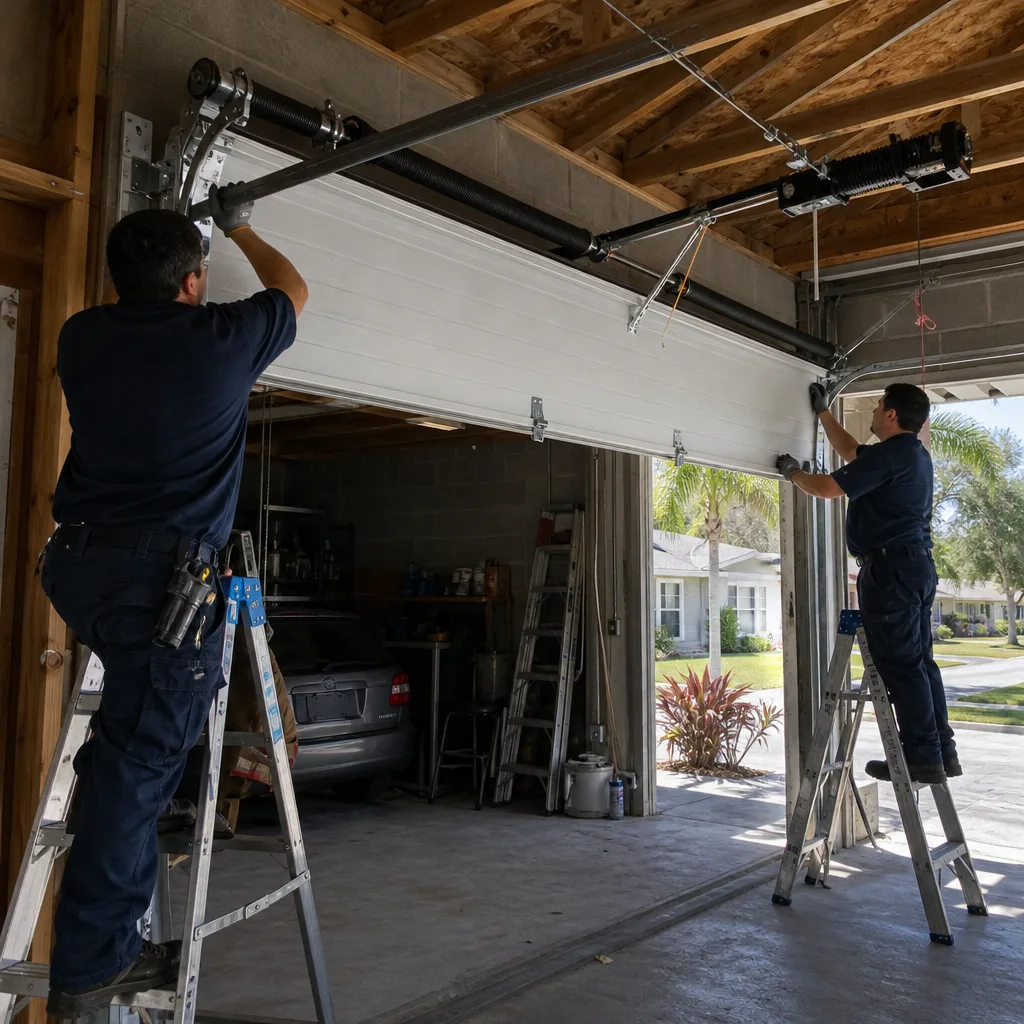
Here’s the practical maintenance rhythm that actually fits this climate. This is a numbered list for a reason: print it, stick it on the garage wall, follow it.
- Every 3 months: Wash the exterior of the door with mild soap and water. In Lakeland’s humidity, mildew will start to form on the panel edges faster than you think. For steel doors, apply automotive wax once a year after washing.
- Every 6 months: Visually inspect the cables, brackets, and springs with a flashlight. Look for frayed cables, rust on brackets, or any gap or separation in a spring coil. Do not touch the cables; just look. If something doesn’t match the other side, call someone.
- Every 12 months: Replace the bottom seal if it’s cracked, brittle, or no longer touching the floor evenly. In Lakeland’s UV, a rubber seal usually shows visible cracking at the two-year mark. Also check the weatherstripping around the door opening.
- Every 12 months: Disconnect the opener and run the door manually. It should lift smoothly with moderate resistance. If it’s heavy, something is failing; a balanced door lifts with one hand and holds at waist height. A heavy door is often the earliest sign of spring fatigue.
- Annually, after storm season: Check the opener’s outlet for a surge protector. If you don’t have one, add one. A $25 surge protector is the cheapest insurance against a $200 logic board replacement.
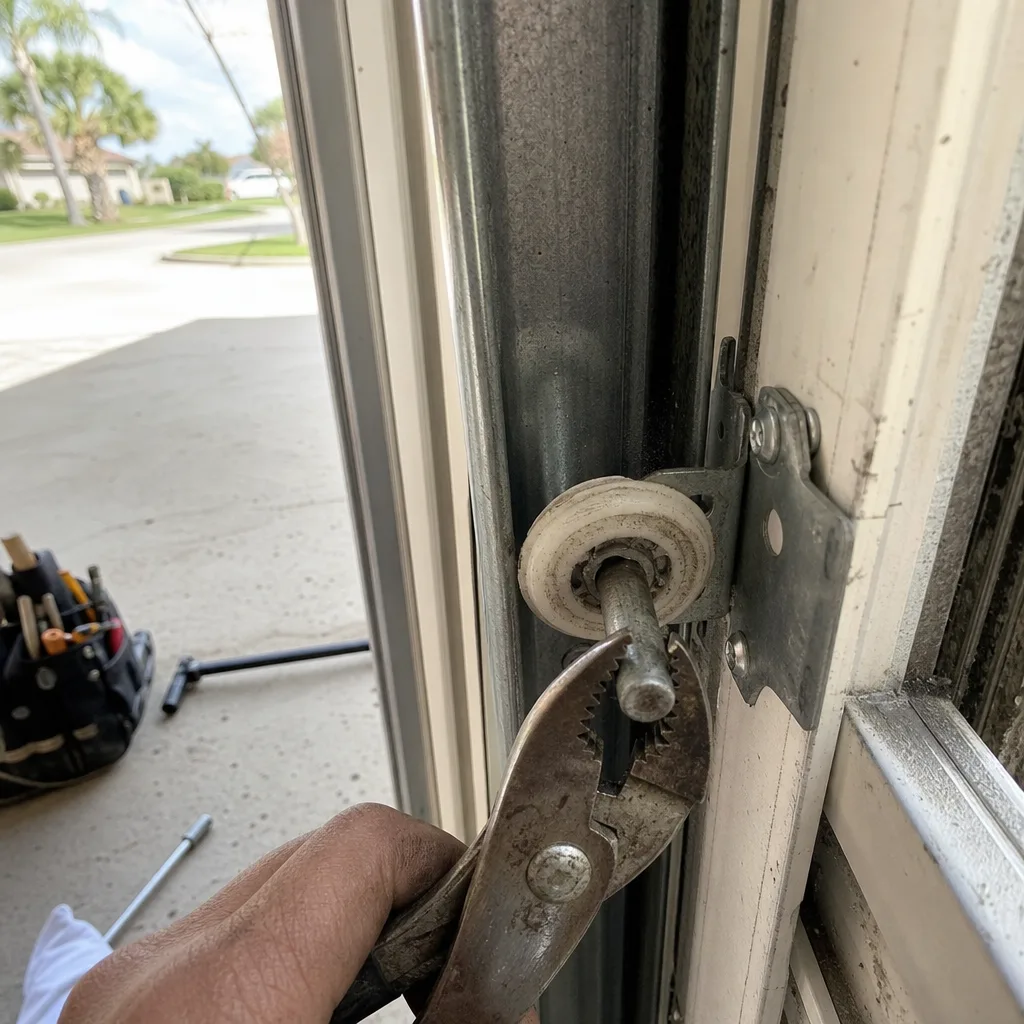
- Annually: Lubricate the hinges and rollers with a silicone-based or lithium-based garage door lubricant. Not WD-40. The track does not need lubrication; if someone tells you to lubricate the track, they don’t understand how these systems work.
Signs Your Garage Door Needs Attention
The following symptoms are not normal, and each one points to a specific issue. This table is what our technicians use as a starting point on every service call in Lakeland.
- The door feels heavy when you disconnect the opener and lift it manually. Spring fatigue or failure. If it won’t hold at waist height, the springs under it are done.
- You hear a loud bang from the garage. That’s a torsion spring breaking. Happens while the door is moving, sounds like a gunshot, leaves the door impossible to lift manually.
- The door opens halfway and reverses. Limit switch setting, or an obstruction in the track, or a failing logic board. If the sensors at the base are lit and aligned, it’s probably the limit settings or the board.
- The door jerks or binds when opening. Worn rollers, debris in the track, or a cable issue. If it jerks consistently at the same point, there’s a physical obstruction or bent track section.
- The door is uneven when closing, with a gap on one side. Cable slip or a broken spring on one side. This will only get worse, and it wears the other components unevenly.
- The opener runs but the door doesn’t move. The trolley carriage has disconnected, often because the emergency release was pulled, or the gear inside the opener is worn out. On older Chamberlain and LiftMaster openers, the plastic drive gear is a known wear item.
- Visible rust on cables, brackets, or springs. This is Lakeland’s signature problem. Surface rust on a spring is one thing; rust that’s causing pitting or scaling means the component is compromised and should be replaced before it fails.
Common Mistakes to Avoid
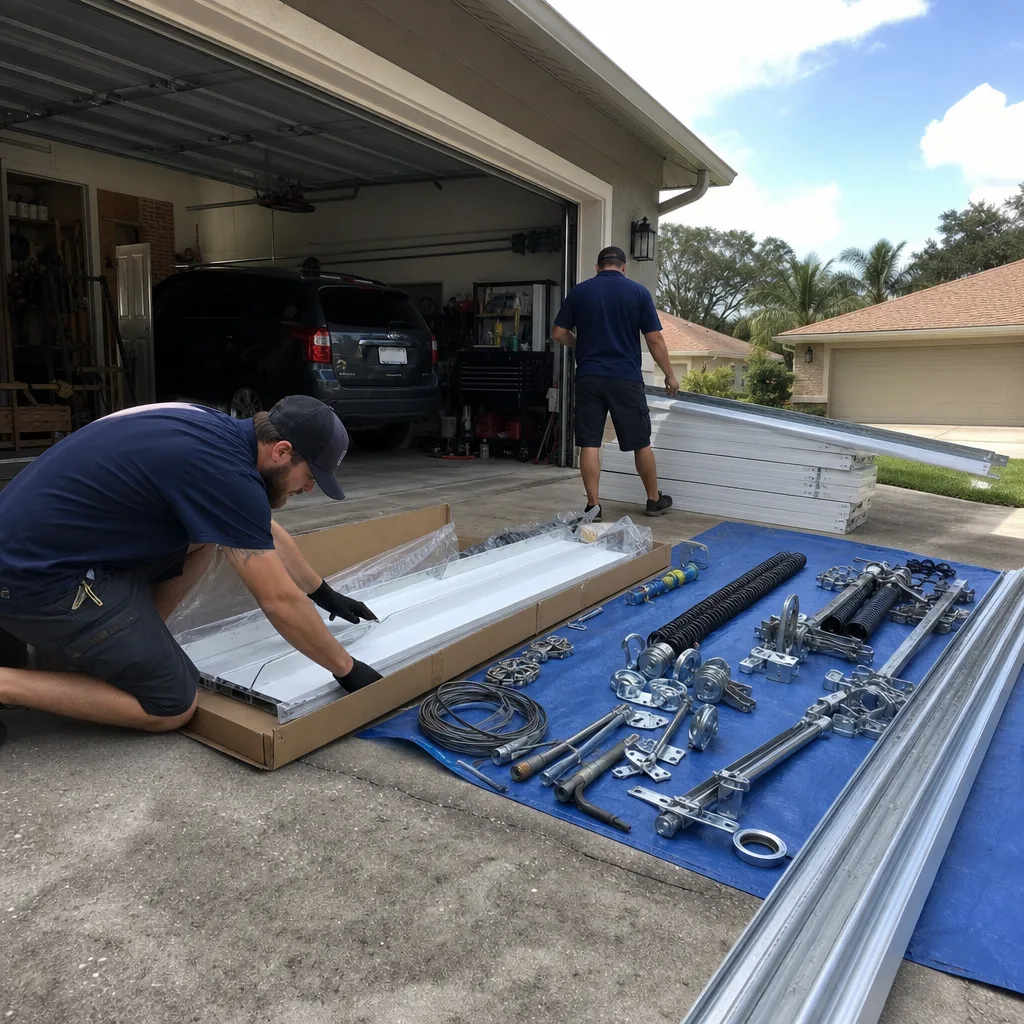
- Lubricating the track. Garage door tracks are not meant to be lubricated. Grease on the track attracts dust and grime, which makes the rollers work harder. Lubricate the hinges and rollers, not the rail.
- Replacing only one spring to save money. If one torsion spring has failed from cycling, the other is the same age and the same number of cycles. Replacing one at a time means paying for labor twice and living with two springs of different tensions, which throws off the door balance. In Lakeland’s climate, a spring at eight years old is done even if it hasn’t snapped yet.
- Ignoring a frayed cable. A frayed cable does not fix itself, and it will not “hold on” for a few more months. When it snaps under load, the door drops, and the repair bill triples. We’ve seen cable failure turn into a $1,500 repair from a $200 one because the homeowner waited.
- Choosing a door material based on a national comparison chart. A door that’s rated “excellent for humid climates” on a generic website might still be sun-faded garbage in Lakeland by year five. Compare materials against Lakeland’s specific conditions, not national averages.
- Accepting a verbal quote. If it’s not in writing, it doesn’t exist. A verbal “around $250” becomes $500 when the invoice is written, and you have no document to point to. This is the exact behavior our company was built to refuse. Written price, scope, and documentation, every time, per Clause 1.
- Using the garage door as the primary entry and exit. Most Lakeland homeowners use their garage door multiple times a day. That’s 1,500-plus cycles a year on a spring rated for 10,000. The math is simple: every cycle counts, and the more you use the door, the shorter the component lifespan. That’s not a reason to stop using your garage; it’s a reason to know your spring’s cycle rating and replace at the right interval.
- Skipping the annual inspection because the door “works fine.” By the time a garage door shows obvious symptoms, the underlying component is usually already failed. The annual inspection catches things before the loud bang at 6 a.m.
When to Call a Professional
This is the short list. If any of these are true, stop using the door and call someone who knows what they’re looking at. A torsion spring that has snapped requires replacing under tension, which is not a DIY job under any circumstances. A frayed or snapped cable means the door is unbalanced and dangerous to move. If the opener is grinding, smoking, or running without moving the door, the motor or the gear is failing. If the door is off the track, every attempt to use it causes more damage. And if you’ve never had an annual inspection and your system is over seven years old in Lakeland, you are statistically at the failure window. Servo Garage Doors Lakeland offers free estimates throughout Lakeland, including the Dixieland, Lake Hollingsworth, and Grasslands neighborhoods, and our technicians arrive with written pricing as the opening move, not the closing one. Call (863) 656-0858 to schedule an inspection or get a written quote.
For more on what a repair visit should look like, see our Garage Door Opener Repair & Installation in Lakeland page.
Frequently Asked Questions
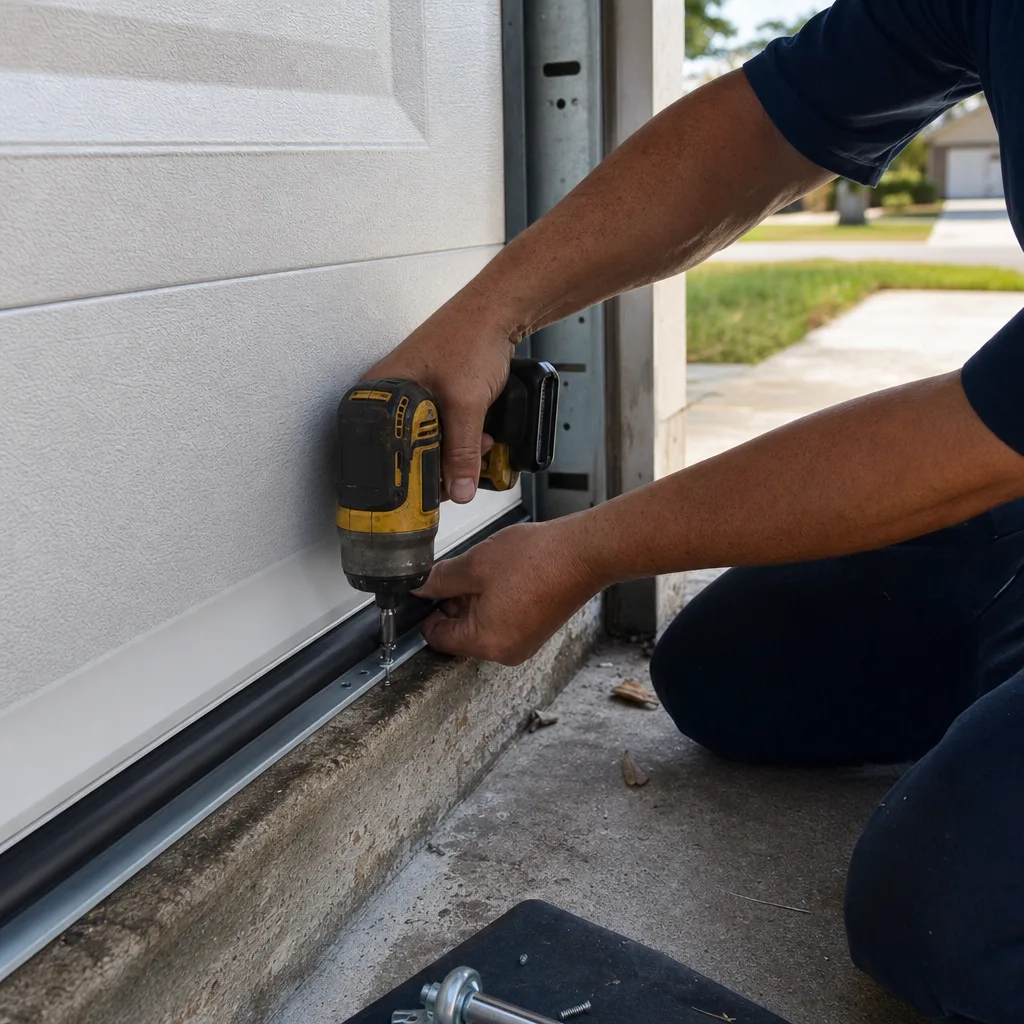
A torsion spring replacement in Lakeland typically costs $180 to $280 for a single spring or $300 to $500 for a pair, including parts and labor. The exact price depends on the spring’s wire diameter, length, and cycle rating. Call (863) 656-0858 for a written quote before any work begins, so the number is fixed before you approve anything.
A steel garage door that’s properly maintained will last 15 to 20 years in Lakeland, but the mechanical components inside it will not last that long. Springs typically fail at 7 to 9 years in this humidity, cables and bottom seals every 3 to 5 years, and opener logic boards are vulnerable to storm surges throughout their life. The door is the last thing that fails; the hardware is the first.
Steel doors from Clopay, Amarr, and Wayne Dalton all perform well in Lakeland when properly finished and maintained, but what matters more than the brand is the gauge of steel and the type of finish. A 24-gauge insulated steel door with a factory finish will outlast a cheaper 25-gauge door from the same brand. The best door in a Lakeland west-facing garage is still going to get hammered by UV, so expect to maintain the exterior finish regardless of brand.
The most common cause is a power surge that has damaged the logic board inside the opener. Lakeland is in the lightning capital of the United States, and homes without surge protection on the opener’s outlet are at much higher risk. If a storm knocks out your opener, unplug it for five minutes and try again. If it’s still dead, the board likely needs replacement, which in most openers costs between $120 and $220 installed.
Replace them before they break. A spring that fails at hour 9,000 of its 10,000-cycle rating gives you no warning and often causes secondary damage to the cables or the track when it snaps. An annual inspection can measure the spring’s wear and cycle count, so you can plan the replacement instead of reacting to it. In Lakeland, the failure always comes at the worst time, which is usually a summer morning when you’re already late.
Compare it against the ranges above, and look for three things: written parts and labor as separate lines, a written scope of work, and warranty terms. If a quote is verbal, vague, or missing the scope, walk away. A fair quote doesn’t require trust; it puts everything in writing so you can read it. Every quote we provide in Lakeland includes a written price, a written scope, and a documented photo record of findings, because that’s how our company has operated since 2015.
The Bottom Line
A garage door in Lakeland is under more mechanical stress than a garage door almost anywhere else in the country. Humidity corrodes the hardware, UV destroys the seals and finishes, and thunderstorms kill opener boards. The homeowners who stay ahead of these problems are the ones who schedule annual inspections, know their spring’s cycle rating, and never accept a quote that isn’t in writing. When you know what the components are called and what service should cost in this market, you’re harder to overcharge and easier to serve. That’s the whole game.
Written by Marcus Deller, Owner at Servo Garage Doors Lakeland, serving Lakeland since 2015.