
Last updated September 20, 2026
Full 25-point door and opener safety check with every visit - springs, cables, rollers, tracks, and your LiftMaster or Chamberlain opener included
You get a price before we start. It does not change when the truck arrives.
 Before
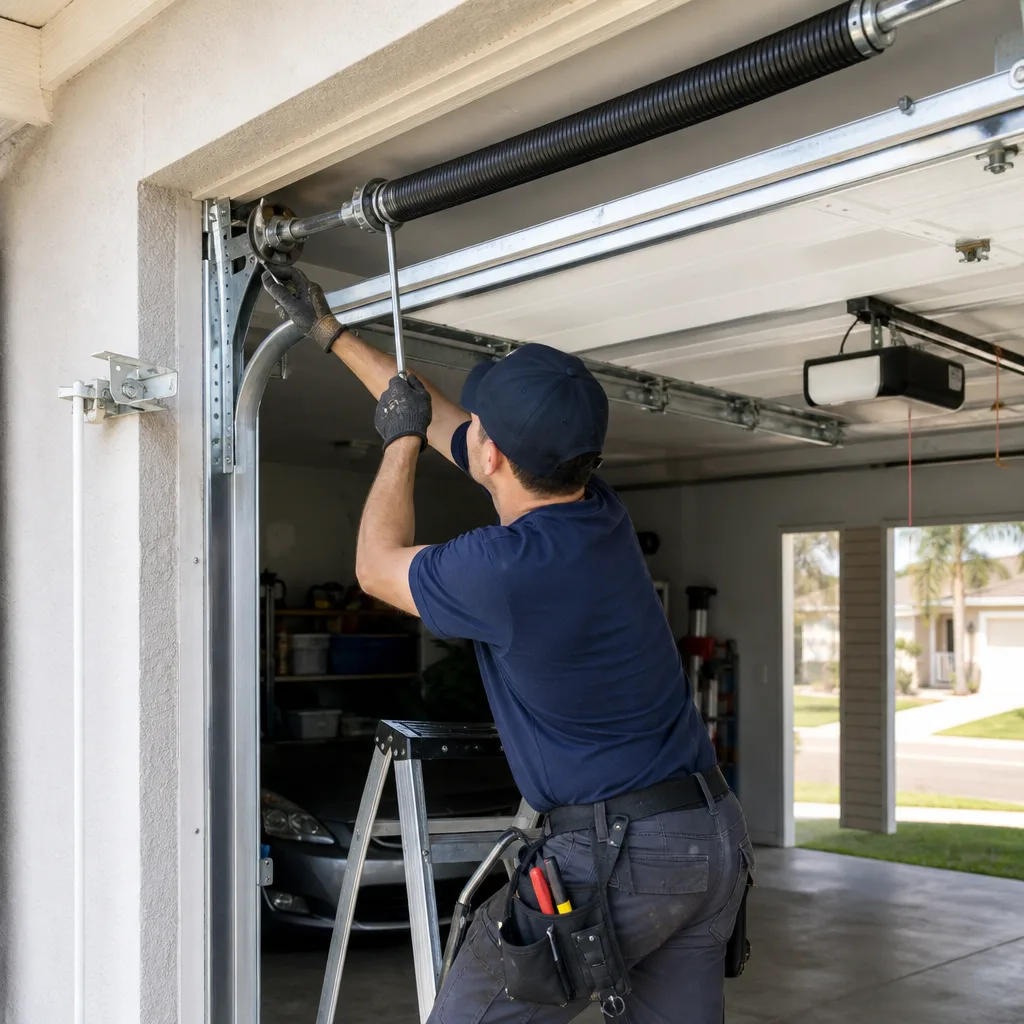 After
After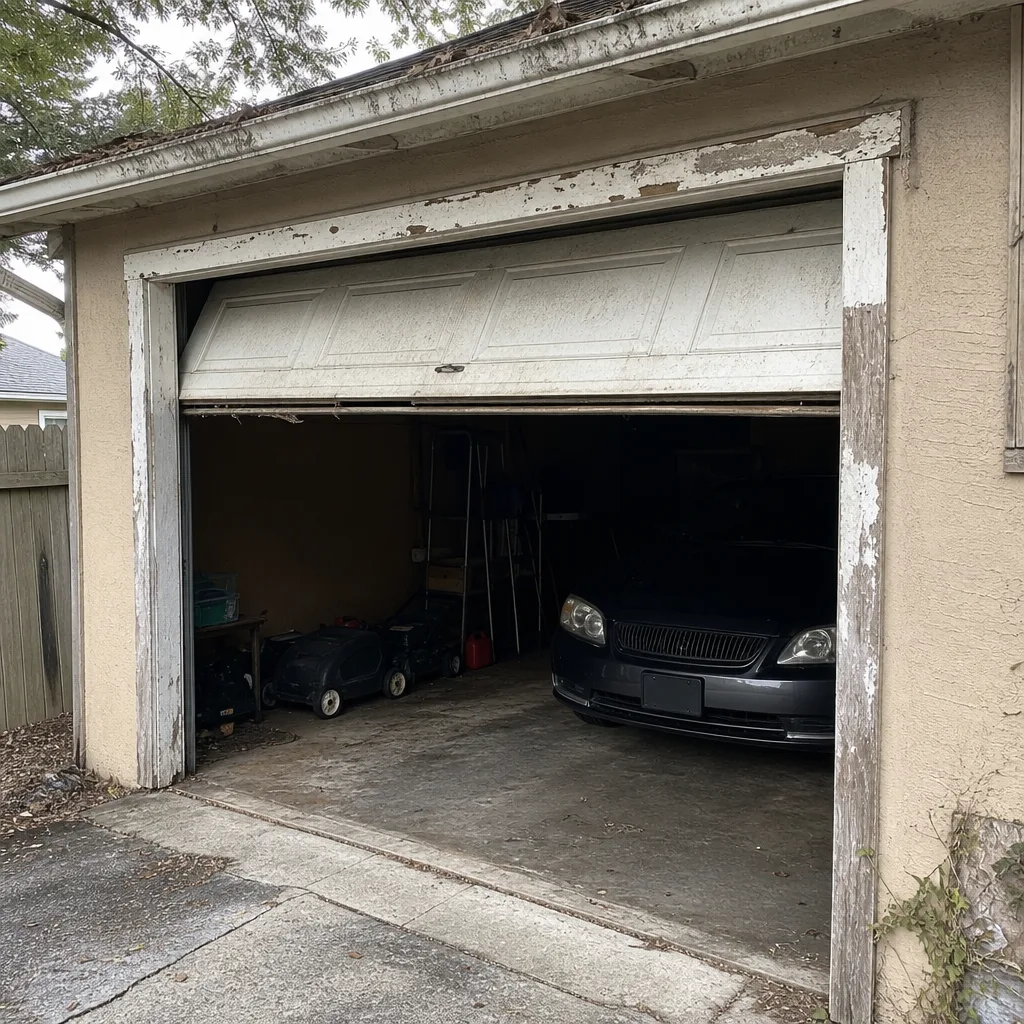 Before
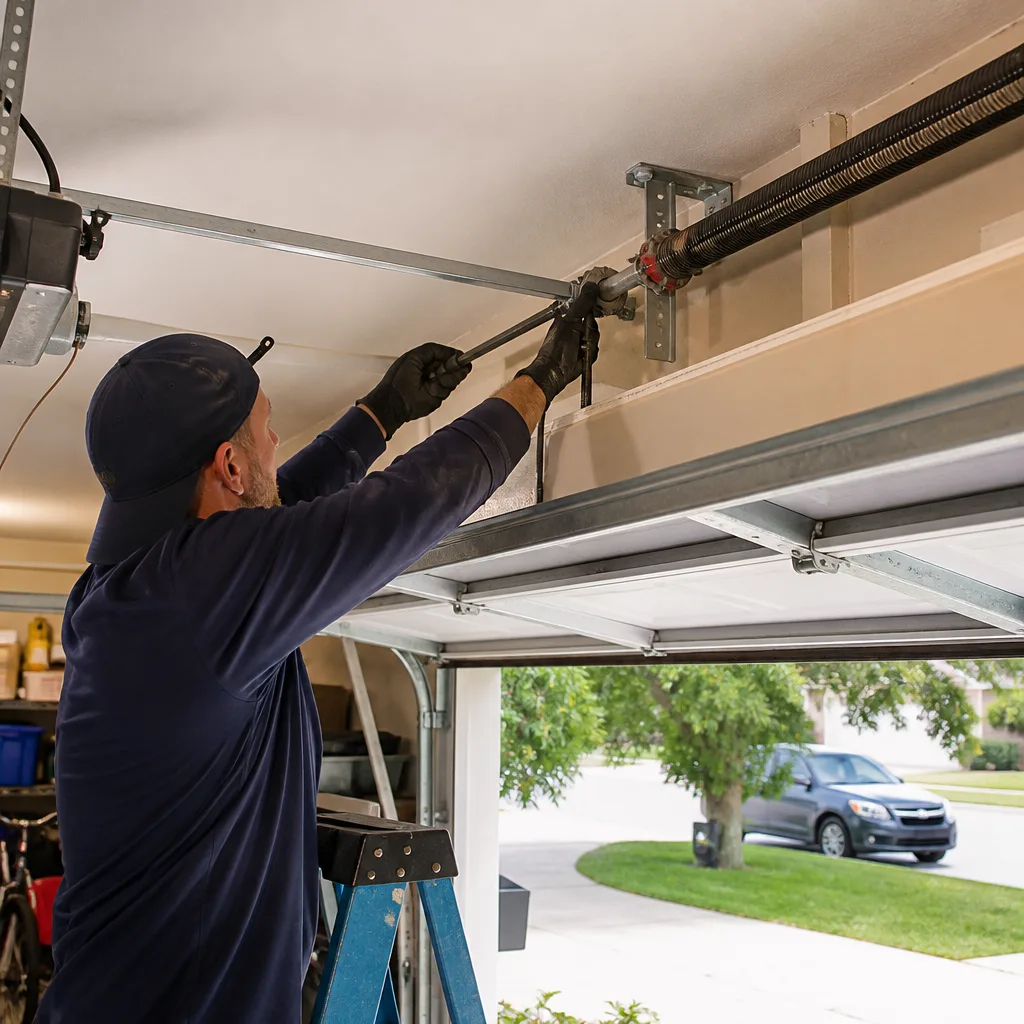 After
After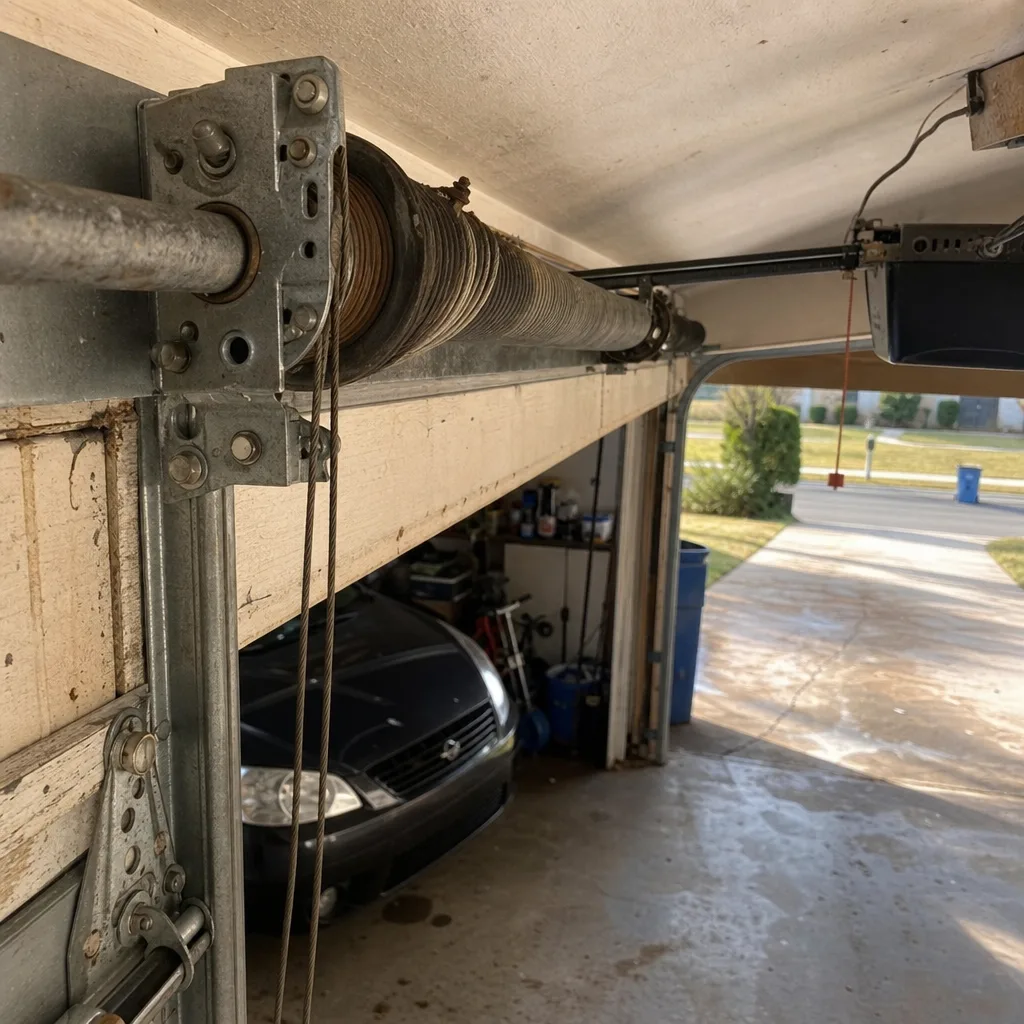 Before
 After
AfterSeasonal Garage Door Care for Lakeland: Year-Round Homeowner’s Guide
Lakeland doesn’t get winter the way the rest of the country does. Walk into any big-box hardware store in January and you’ll see shelf displays telling you to lubricate your garage door for freezing temperatures - advice that means nothing at 28 degrees north latitude, where our coldest morning rarely drops below 40°F. What Lakeland actually has is a four-part climate cycle that national maintenance guides never address: a February-to-April pollen season that coats every moving part in fine yellow dust, a May-to-June dry heat that bakes rubber seals until they crack, a June-to-November storm window where afternoon thunderstorms arrive almost daily, and a short December-to-January reprieve that is the single best time to do preventive work on a door. This guide is written by the team that services garage doors across Lakeland, from Dixieland to Grasslands, and it maps maintenance to the calendar. For a deeper look at everything from styles to safety, see The Complete Guide to Garage Door in Lakeland.alendar we actually live by. You’ll learn which three components fail most often in hurricane season, why your opener works harder in March than in August, and what to do during the one month of the year when the weather gives you a free pass to work on your door. Each step takes under an hour and costs less than twenty dollars in materials, except where noted.
Quick Answer
Seasonal garage door care in Lakeland means a four-part routine: clean pollen out of tracks and rollers between February and April, inspect and tighten all hardware before the June hurricane-season wind loads arrive, check bottom seal contact against afternoon rain patterns through the summer, and apply a UV-resistant silicone treatment to rubber seals during January, the driest month. The total material cost for annual maintenance runs $35 to $85. The most often skipped step is the pre-June 1 hardware inspection, and that’s the one most likely to prevent a door failure when wind pushes against the panel face.
Table of Contents
- Lakeland’s Climate Calendar: Four Seasons, Re-named
- January: The One Dry Month and What It’s Good For
- Pollen Season (February-April): Track and Roller Cleaning
- Pre-Hurricane Season (May-June): Hardware Inspection Protocol
- Summer Afternoon Rain and Bottom Seal Contact
- Fall Storm Window and Post-Hurricane Check
- Year-Round Opener Care: Logic Board and Force Settings
- Tools and Materials: What You’ll Actually Need
BeforeAfterLakeland’s Climate Calendar: Four Seasons, Re-named
Here’s the calendar we use when scheduling our Lakeland garage door service calls, because it matches what we see in the field. Hurricane season runs June 1 through November 30, with the highest wind-load failures we repair occurring in August, September, and October. Pollen season in Polk County starts in February, peaks in late March, and tapers by late April; what we see on garage door tracks during that window is a mix of oak pollen, pine pollen, and fine dust that gets airborne while the ground is dry. Lakeland’s summer rain pattern is dominated by afternoon convection thunderstorms: most days from late May through September, a storm forms between 3:00 and 6:00 p.m., drops a hard, short burst of rain, and clears by evening. December and January are the driest consecutive months, with average rainfall under 2.5 inches each. Wind is a year-round factor in Lakeland, but the peak wind months are the hurricane season months, full stop. And the heat: Lakeland averages about 100 days a year at 90°F or hotter, concentrated between May and September, which is also the period when rubber and nylon components take the most UV damage. Understanding this calendar matters because the work your garage door needs in Lakeland is not evenly distributed across the year. You don’t lubricate in October here; you inspect for storm damage and adjust bottom seal. You don’t wait until “winterizing” season; by the time the national guides tell you to work, you’ve already missed the dry window for several key tasks.
What you’ll see in the rest of this guide is built around this calendar, not around a four-season template from the Midwest. Each section names the window, what’s actually happening to the components, and the specific action to take. Some of these are things any careful homeowner can do in an afternoon. Others - torsion spring adjustment, cable inspection under tension, logic board diagnostics - are jobs where the wrong move creates a risk of injury, and in those sections, we’ll say exactly where the line is between homeowner task and professional repair. If you’re weighing whether to DIY or call a pro, our DIY vs Professional Garage Door: The Lakeland Homeowner’s Decision Guide breaks down the factors. We’ve serviced more than 18,000 garage doors since 2015, and every one of those visits closed with a written record and a photo file of what we found. If you want to work on your own door, this guide won’t gatekeep the basic steps. It will tell you where the danger lives.
January: The One Dry Month and What It’s Good For
The national advice to “prep your garage door for winter” means something different in Lakeland. Here, January is not about cold contraction or ice buildup - it’s the one month of the year when the humidity drops low enough and the rain stays away long enough for rubber compounds to actually hold a treatment. If you do one preventive task on your garage door in an entire calendar year, do this one, and do it in January.
The task is treating rubber weather seals - the bottom seal on the door panel and the side and top seals on the frame - with a UV-resistant silicone treatment. Here’s what the door components in Lakeland are up against. Rubber and flexible PVC compounds degrade under two conditions: direct ultraviolet exposure and repeated wet-dry cycling. Lakeland delivers both. Florida’s UV index averages high from March through October, and our afternoon thunderstorm pattern means any rubber exposed at a threshold gets soaked and then baked within a two-hour window. The bottom seal on a garage door in a west-facing or south-facing house in Lakeland takes a measurable hit from this cycle. By the time that seal is three years old, micro-cracks at the hinge points and corners are common, and those cracks are where water gets in during summer downpours and where ants and palmetto bugs find a gap. A homeowner applying a UV-resistant silicone treatment to those seals once a year, every January, extends the life of a $35 to $50 bottom seal by two to three years. That’s not a trade secret; it’s basic materials science. Silicone doesn’t cure into a hard film the way some rubber treatments do, so it stays flexible during the spring pollen season and doesn’t flake off in July heat.
Here’s the order to work in. Start with the bottom seal. Open the door to knee height. Look at the rubber retainer that runs along the bottom edge of the panel. In Lakeland, the most common failure points are the two corners where the seal folds into the vertical track, and the center seam where a door that is wider than 16 feet has a splice. Wipe the seal clean with a dry rag to remove dust and accumulated pollen film. Apply UV-resistant silicone spray in a thin, even coat. Work the door down to the closed position, open it again, and check that the seal still made flat contact along its entire length. Then do the same for the side and top weather strips on the frame. One can of silicone treatment costs $12 to $20, and a full treatment takes under an hour.
January is also the month to inspect the seal contact along the floor. Every slab in Lakeland settles differently; older homes in the Lake Hollingsworth and Beacon Hill areas have slabs that have moved enough to leave a visible gap under the center of the door, while newer construction in the north Lakeland subdivisions typically has a flatter grade. If the seal doesn’t contact the slab along its full width, lay a level on the floor and note where the gap is. The fix for a small gap is a thicker or differently-profiled bottom seal; the fix for a large gap is slab leveling or a door re-hang, both of which are professional jobs. If your door closes and you can see daylight under the seal, water intrusion and pest entry are guaranteed in the next storm season - address it now, while the door is dry and the work is fast. For the exact seal profile that works on Lakeland concrete slabs, see the summer section below; the product matters more than most people think.
Pollen Season (February-April): Track and Roller Cleaning
Pollen is a maintenance issue in Lakeland, and the part of the garage door system it damages first is the operator, not the door. Here’s the mechanism. In February, Polk County oak trees release pollen; in March, pine pollen arrives on top of it. Pollen particles are tiny - under 100 microns across - and they are electrostatically attracted to metal and nylon surfaces. They accumulate inside the track channels and on the roller stems, where they mix with the light lithium grease that the track and rollers carry. The result is a paste that has the consistency of thick clay and increases rolling resistance along the track from near zero to something like 20 to 30 pounds of additional pull. A Chamberlain or LiftMaster operator that is rated for a certain door weight and duty cycle is now pulling against a door that is no longer moving freely, so the operator runs longer, runs hotter, and works every time the door cycles. We have diagnosed more thermal-overload failures in Lakeland between March and May than any other time of year, and the root cause is usually this pollen-and-grease paste, not a failing motor.
The fix is simple enough to do yourself, if you stay within one rule: everything you do during pollen season is done with the door closed and the operator released. Pull the red emergency release cord on the opener rail to detach the door from the trolley. Never clean a track or roller on a door that is still connected to the operator and under tension from the springs; even a door that is disconnected can still have tension in the torsion spring, so keep your hands out of the spring assembly entirely.
Here’s the order of work.
- Close the door fully. Release the opener with the red cord.
- Wipe the interior of each vertical track channel with a dry rag. The track channels are the U-shaped metal guides that the rollers ride in; you’re cleaning out loose pollen film. If you see paste, use a plastic scraper to lift it out, not a solvent.
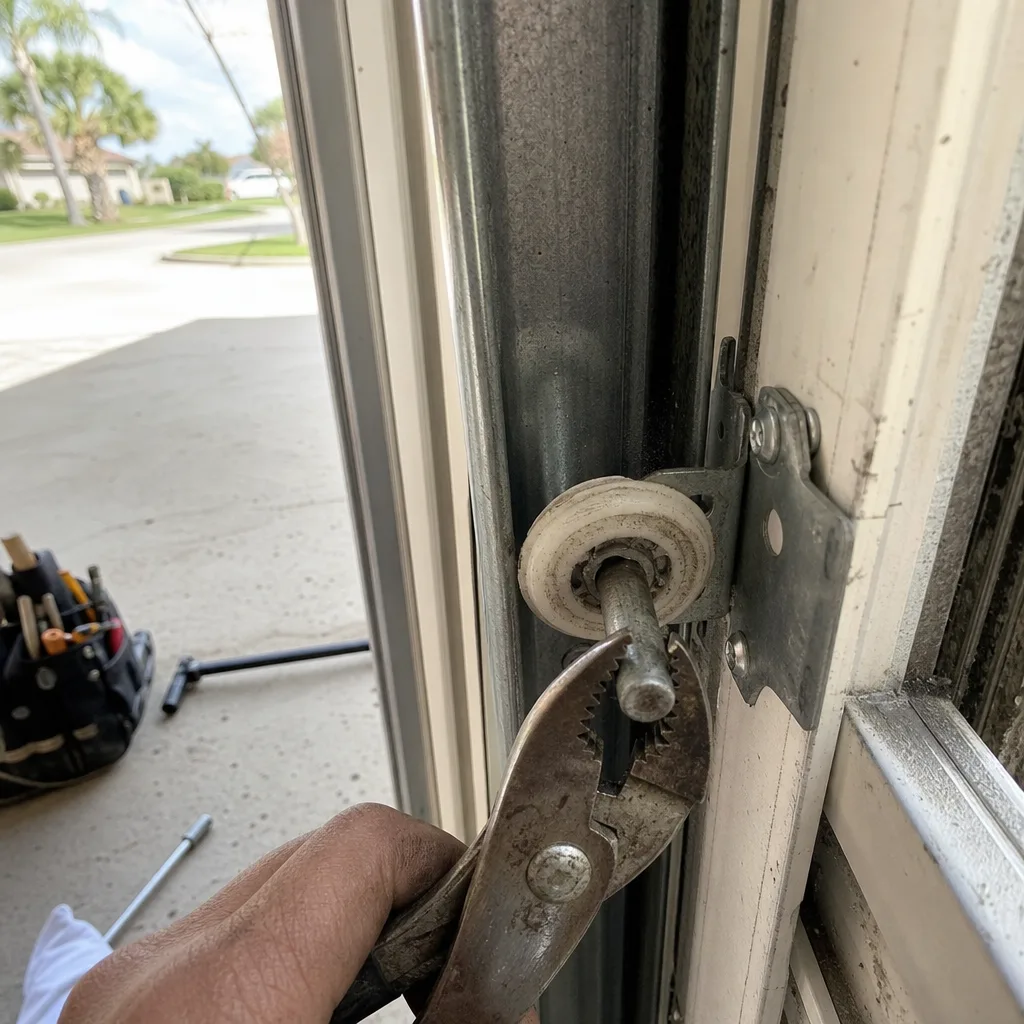
- Wipe each roller stem and roller wheel with a clean rag. The stem is the shaft the roller wheel spins on, and it’s where pollen paste builds up first. If a roller feels gritty or wobbles, that’s a wear item, not a cleaning job. Replacement nylon rollers run $8 to $15 each in Lakeland, and a door uses eight to twelve of them.
- Apply a thin film of white lithium grease to the roller stems only. Do not grease the track channels. Greasing the track channels is the most common homeowner mistake we see in Lakeland, and it creates the exact paste problem we’re trying to prevent. The track channel should stay dry; the roller stem takes the grease.
- Reconnect the opener using the red release cord, run the door through two full cycles, and listen. A door with clean rollers and stems should produce a low smooth hum. If you hear grinding, squealing, or chattering, a roller or hinge is the culprit; move to the next item before blaming the opener.
The cleaning itself takes 45 minutes. The payoff is specific: a door that moves freely through a February-to-April window in Lakeland is a door that doesn’t drag on the operator, and an operator that isn’t dragging is an operator that doesn’t trip its thermal cutout on a 90-degree day. If you run this cleaning and still hear a strain or see jerky motion, the problem may be in the limit-switch settings or the travel force profile of the opener’s circuit board, and that’s where a homeowner should hand off to a professional. We carry Genie, Chamberlain, and LiftMaster parts on the truck and quote every replacement with a flat written price before the work is touched - Clause 1 of The Haven Standard is exactly this, and there’s never a reason to call for a quote.
Pre-Hurricane Season (May-June): Hardware Inspection Protocol
June 1 is the date on the calendar, but the right time to do this work is the two weeks before it, from mid-May through the end of the month. Here’s the Lakeland-specific reason: the wind loads that matter for a garage door don’t come from the hurricane itself arriving as a direct hit. They come from the outer rain bands and feeder bands that arrive 24 to 48 hours before the storm center, and from the afternoon thunderstorms that are already a daily occurrence by late May. A door that has a loose bottom bracket, a fraying cable at the drum, or a wall-mount lag screw that has pulled out will reveal itself during one of those weaker wind events. Better that it happens on a clear May afternoon when you can see the failure starting than at 2 a.m. in August when a storm band is pushing against the door face with steady 40 mph gusts.
The inspection protocol below is organized by component, from the parts that fail most often under Lakeland wind conditions to the parts that rarely fail but matter when they do. It’s a checklist, not a narrative, because it has to be done in order.
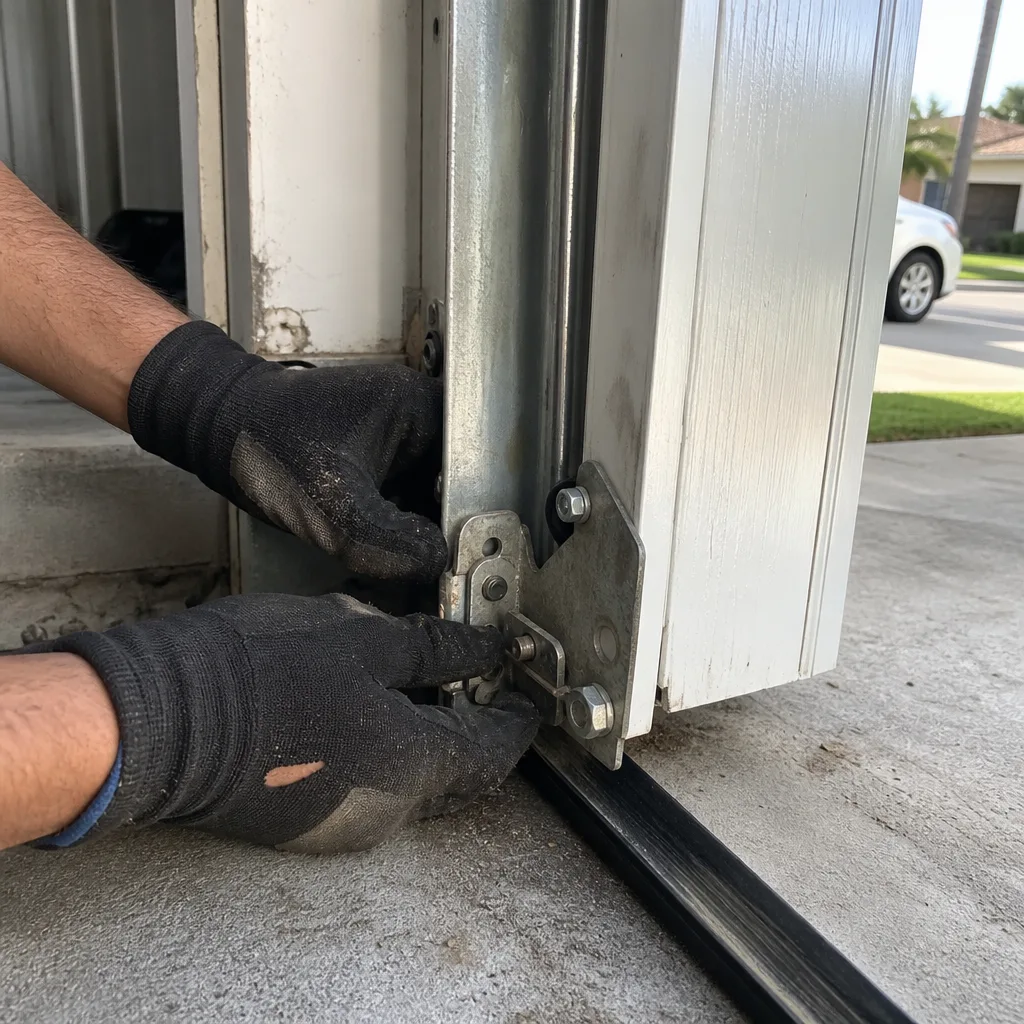
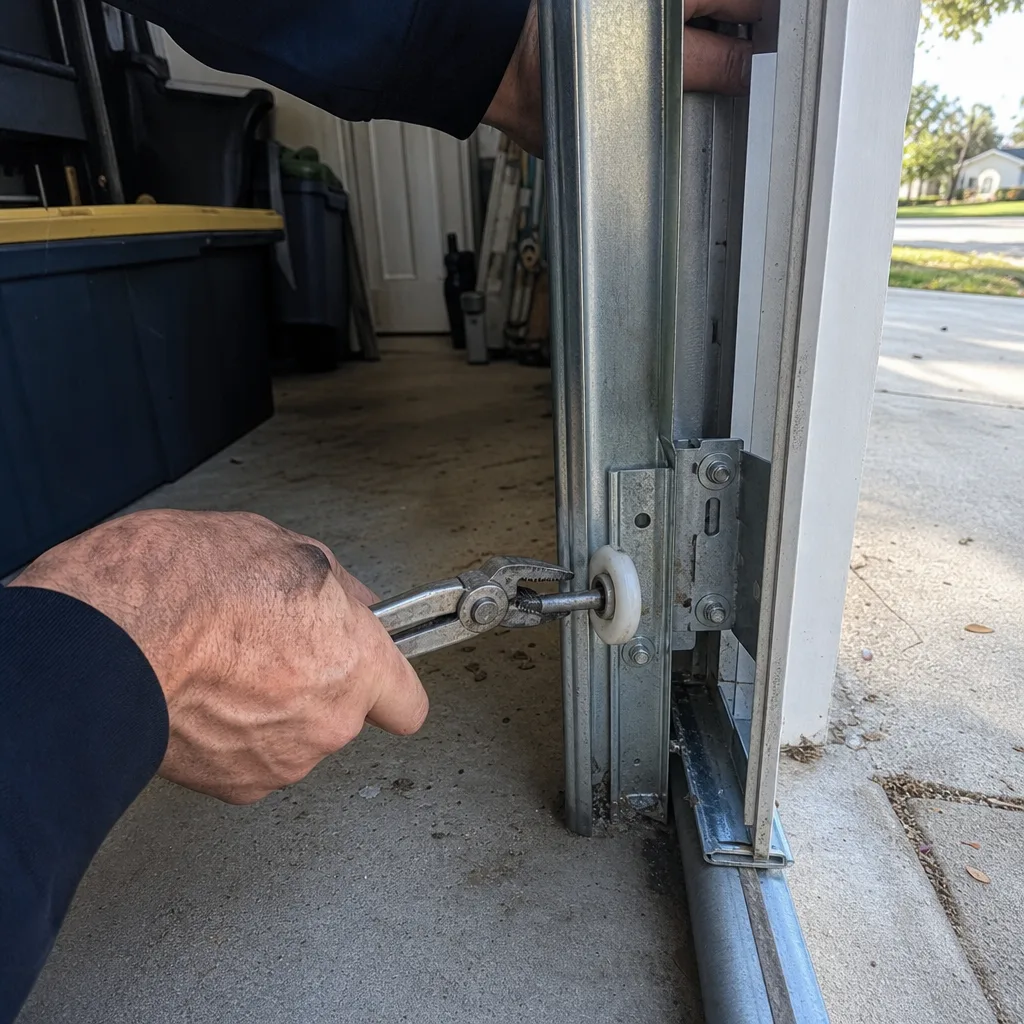
- Bottom brackets. These are the two steel brackets that attach the lowest panel to the cable and the roller stem, one on each side. In wind events, the bottom panel takes more lateral pressure than any other part of the door because it has the most surface area at the point where the wind exits under the door. Look at the fasteners: they should be tight, the bracket should sit flush against the door section, and there should be no gap between bracket and panel. A gap means the panel has shifted; a shifted panel means the cable tension is now unequal, and under wind load, unequal cable tension is how you get a door that jumps the track.
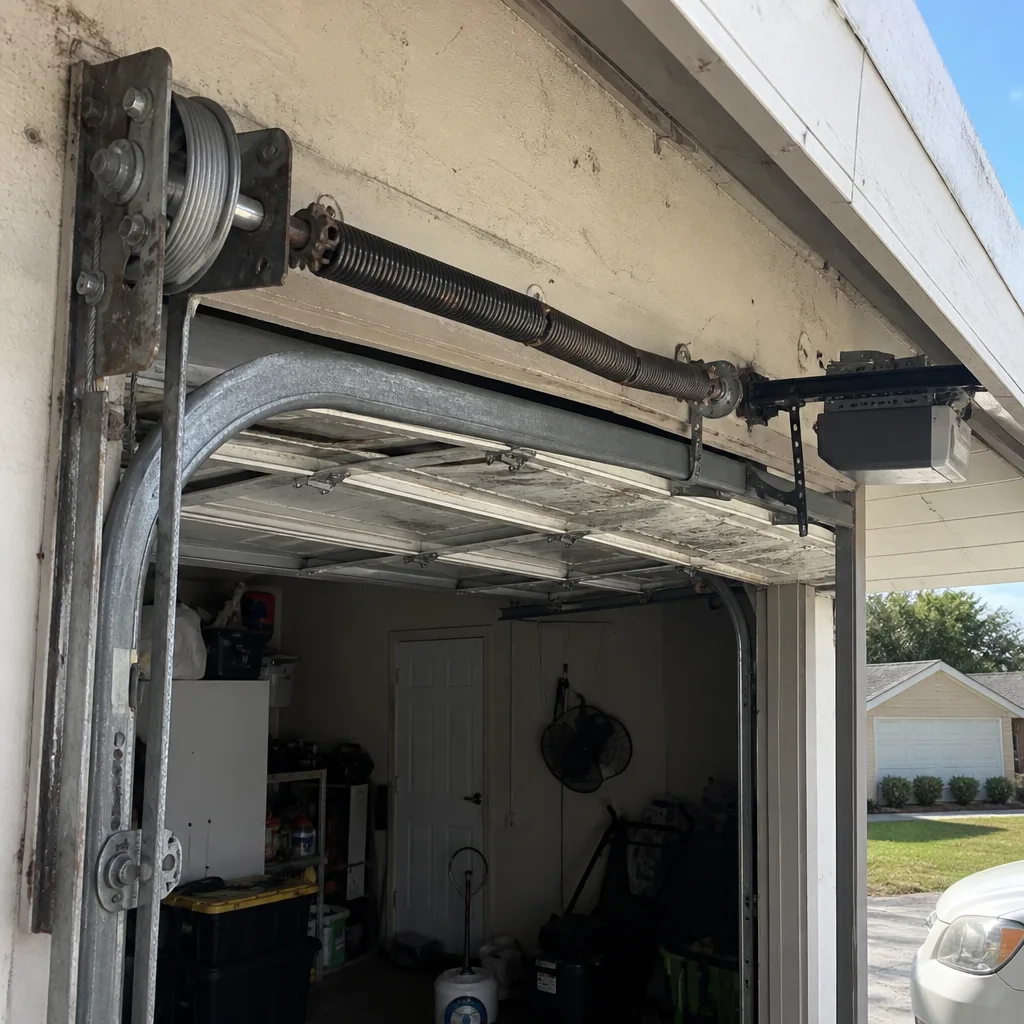
- Cable drums and cables. The cable drums are the two conical spools at each end of the torsion shaft, just above the door. The lifting cables wind onto them. In Lakeland, we see two cable failures during the hurricane season: frays near the bottom bracket where the cable passes through the anchor, and cuts where the cable has rubbed against a misaligned track. Look at the full length of each cable, from bottom bracket to drum. Any broken wire strands, any flattened spot, any rust-colored staining at the anchor point - that cable gets replaced before the wind test, not after. This is one of those components we photograph before quoting a replacement, per Clause 4 of The Haven Standard, so you see exactly what we see.
- Track mounting hardware. The vertical tracks are bolted to the door frame with lag screws, and the horizontal tracks hang from the ceiling with angle iron. On a Lakeland home with a block exterior wall, the lag screws are going into either the block itself or a wood buck behind the casing. On a frame home, they’re going into the king stud. Either way, you’re checking for pull-out: a lag screw that has backed out a half inch or more, a track that moves when you push on it, or an anchor point that has rust bloom around it. Wind pushes the door, the rollers push the track, the track pushes the fasteners; a door that’s been through even one moderate wind event with a loose track will wallow out the hole and make the next event worse.
- Center hinge and top strut. The strut is the horizontal steel reinforcement bar across the inside of the top panel. It should be straight and tight. The center hinge carries the weight of the door sections as they pass the track radius. If it is loose, the sections begin to separate and wind loads act on the gap. You can check both by running the door up halfway and looking for any deflection or daylight between the sections.
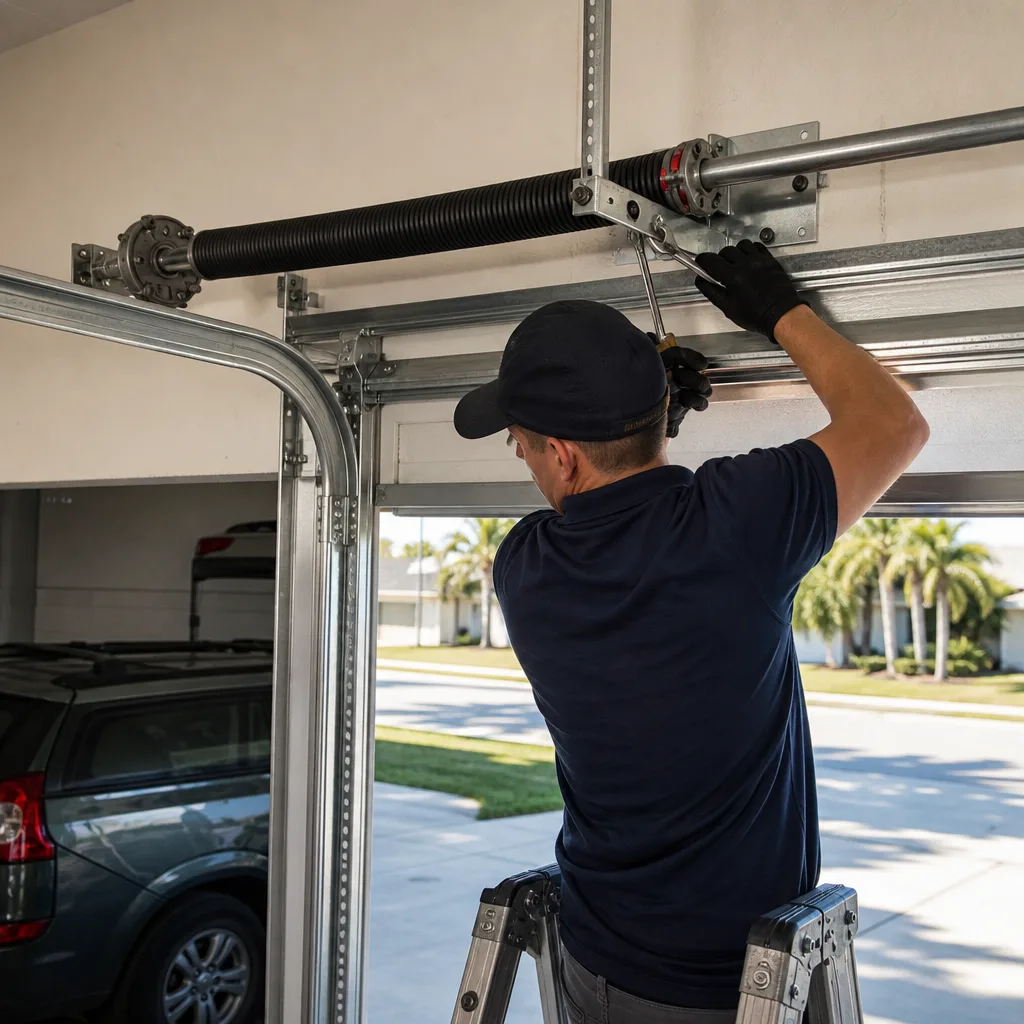
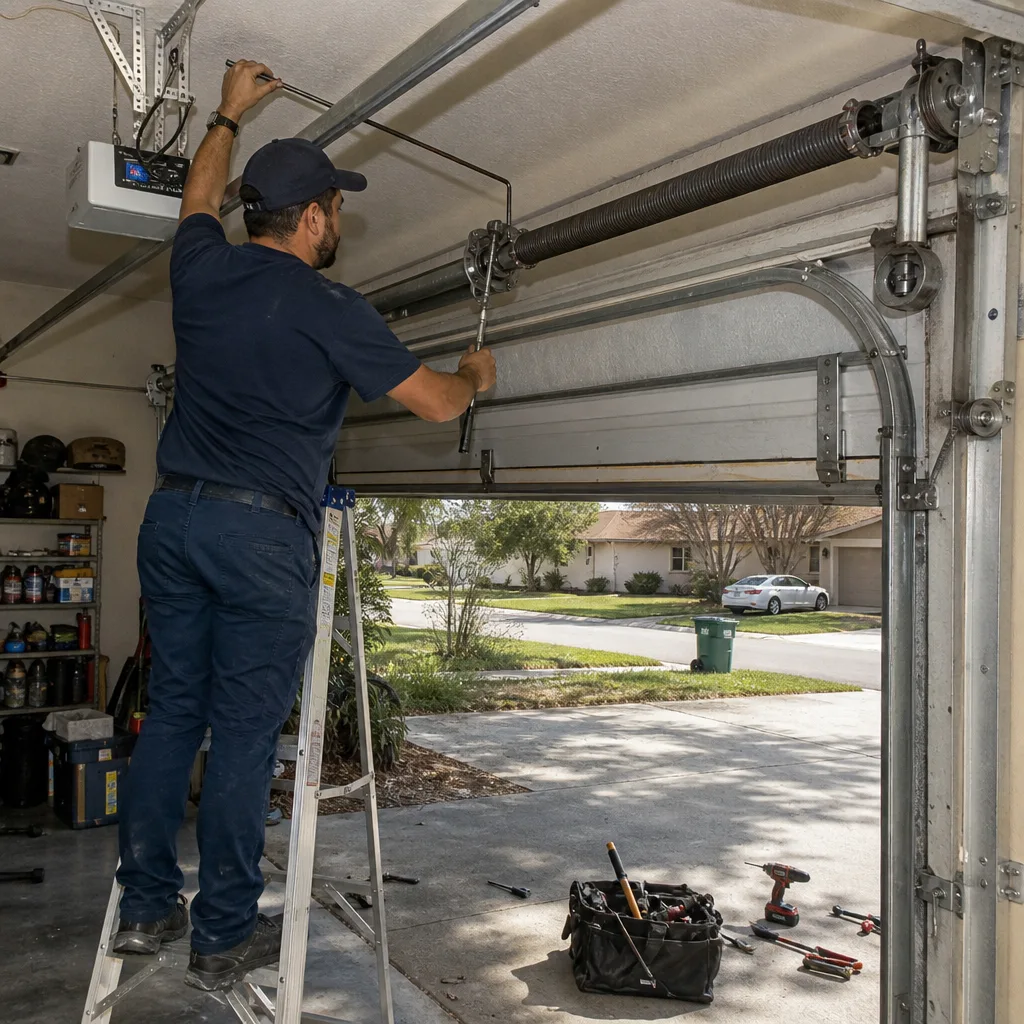
- Spring mounting pad and bearing plates. Look at the torsion spring assembly above the closed door. The center bearing plate should be perpendicular to the shaft, with no looseness at the bolts. The spring mounting pads at each end should be tight against the header. Do not touch the spring or any part of the torsion assembly while inspecting - your check is visual only. Torsion springs are under hundreds of pounds of rotational tension even when the door is closed, and a spring that breaks during a wind event releases that energy in a few milliseconds. In a Lakeland storm, the wind isn’t what breaks the spring; it’s the additional force a binding door puts on already-fatigued coils.
This protocol takes 20 minutes. If everything checks, you close the door and move on. If one item fails the check, the fix is a professional repair - with one exception: a lag screw that has backed out can be re-driven if the hole is still sound. Everything else on this list involves components under spring tension, and a mistake with a winding bar or a cable under load is how people lose fingers or worse. If you’re a homeowner in Lakeland and you find a problem during this inspection, you can bring us the written estimate from any other company, and we will provide a free second opinion. Bring the paperwork. We’re at Garage Door Repair in Lakeland with the same flat-price, written-first approach on every call.
Summer Afternoon Rain and Bottom Seal Contact
In Lakeland, the garage is often the lowest point on the ground floor, and the bottom seal is the only barrier between the slab and the water that sheets across the driveway during an afternoon downpour. The math on this is straightforward. A single Lakeland thunderstorm can drop an inch of rain in 45 minutes, and a driveway has a slope. The water doesn’t pool; it runs. If your bottom seal has a 1/8-inch gap anywhere along its length, that water runs right under the door and into the garage, every single time it rains, for four months straight. By August, that gap has become a permanent water stain, a rust bloom on the bottom bracket, and the source of a “musty garage” smell that is actually mold growth in the concrete.
The correct seal profile for a Lakeland concrete slab is a question we answer on service calls all summer. The answer depends on how the slab has moved and how the driveway meets the slab. Most garage floors in Lakeland are poured concrete with a slightly rough finish, and over time, the slab settles unevenly. If the slab has settled in the middle, the door panel sits flush at the corners but leaves a gap under the center; the correct seal is a compressible rubber T-profile in a heavier gauge, usually 3/8-inch or 1/2-inch bulb, that compresses to fill the low spot. If the slab has settled at the outer edges, the fix is often a door bottom retainer adjustment, and if the slab has cracked or spalled at the threshold, the seal is fighting a losing battle - the repair is a concrete patch or slab overlay, not a thicker piece of rubber. We tell our Lakeland customers this directly, because selling a thicker seal to a homeowner whose problem is the slab itself is how you get a door that closes, then reopens three inches when the seal catches on the cracked concrete. The correct fix is the one that matches the failure, and you can see that in the photo record we give you before anything is ordered.
What you can do yourself in the summer is the contact check. On a bright sunny day, close the door and walk the inside perimeter. If you see light under the seal anywhere, that’s a gap, and you’ve found your water entry point. Mark the gap with masking tape, then open the door and look at the seal at that mark. If the rubber is compressed flat and the gap is under the seal, the slab has dropped; the seal can’t fill the space. If the seal is curled, torn, or pulled out of the retainer channel, the seal itself is the failure, and that’s a $35 to $50 part. You can replace a bottom seal yourself with a screwdriver and about 30 minutes of work, as long as you don’t need to rebalance the door. If the seal is held in by a retainer that has rusted through or bent, the repair is a door-bottom retainer replacement, which is a job for a professional with the door properly supported.
Fall Storm Window and Post-Hurricane Check
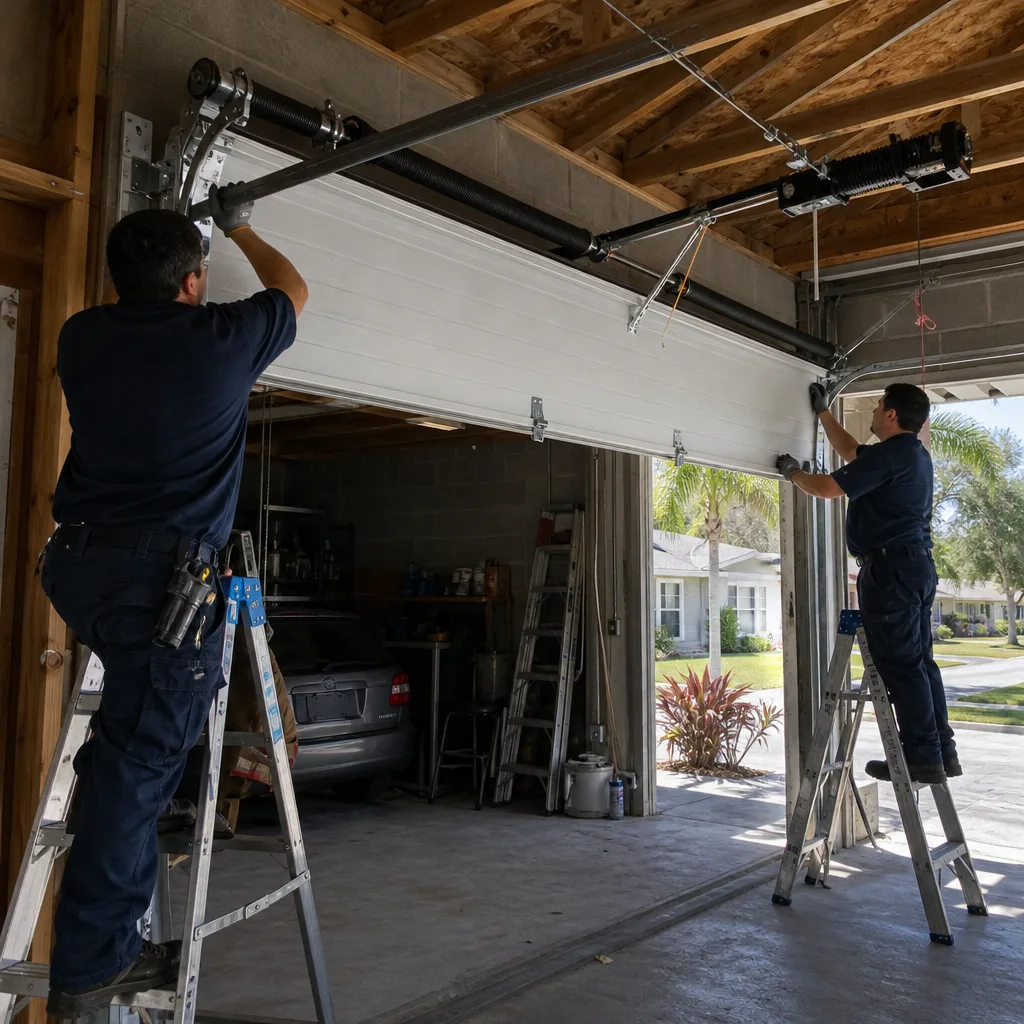
By September, the door has been through the summer pattern: daily UV, daily thermal expansion of the aluminum and steel, repeated wetting and drying of every component near the threshold. The pre-hurricane inspection you did in May is now six months old, and the door has cycled a few hundred times since. The fall check is shorter - one pass, five items, and the goal is to catch the damage that accumulates silently. In Lakeland, the peak month for post-storm garage door calls is October, specifically the week after the first strong front of the fall pushes through and a door that has been barely hanging on suddenly reveals itself. Here’s the checklist, in order, on a dry weekend in late September or early October.
- Re-torque the track fasteners. A 7/16-inch socket on every lag screw, top and bottom, both vertical tracks. A quarter-turn if they’re loose, no more. On Lakeland block homes, if you feel a screw spin in the hole without tightening, the hole has stripped; call a professional before the track works fully loose.
- Run the door through two full cycles and listen at the radius. The radius is the curved junction between vertical and horizontal track. Popping, grinding, or a “chain rattle” sound at the radius usually means a roller is wearing or a hinge pin is loose. You can spot a bad roller by looking at it from inside the garage as the door moves.
- Inspect the cable anchor points at the bottom brackets. This is the same check you did in May, repeated. Rust-colored staining or broken wire strands mean the cable is near failure. Under no circumstances do you touch the cable or the spring; this is a visual check and a phone call if you find damage.
- Check the top panel for sag or bowing. A door that has taken repeated wind events often shows it at the top panel first, because that panel carries the strut and has the most cosmetic surface area. Push lightly on the center of the top panel from inside. Any flex of more than a half inch means the strut is failing or the panel itself has lost its reinforcement; both are professional repairs.
- Run the opener and watch for hesitation. If the door pauses mid-travel and then resumes, the opener’s travel sensor or force settings have drifted. This is a symptom of several possible causes, and the diagnosis starts with the opener’s logic board, not the motor. We handle Garage Door Opener Repair & Installation in Lakeland with flat written pricing, and we show you the board reading on a diagnostic photo before we quote a replacement.
Year-Round Opener Care: Logic Board and Force Settings
The opener is an electronic device, and in Lakeland, the two environmental factors that shorten its life are heat and power events. The heat part is intuitive: a garage in a Lakeland summer reaches 110°F or higher on a mid-afternoon, and the logic board inside the opener’s plastic housing is being thermally cycled every day. The power part is less intuitive but more damaging. Lakeland’s afternoon storms are accompanied by frequent lightning, and a nearby strike induces a surge on the household circuit that can take out a logic board in one instant, even if nothing else in the house fails. In our experience, the most common opener failure we replace in Lakeland is not the motor; it is the logic board, and the board fails in three ways: a storm surge, heat-related component breakdown, or a slow death from being overworked by a door that doesn’t move freely.
The overwork failure is the one you can prevent, and it ties back to the pollen-season cleaning described earlier in this guide. Operators from LiftMaster, Genie, and Chamberlain are factory-calibrated for a specific door weight and travel resistance. When that resistance rises because pollen has become paste in the tracks, the opener increases its motor current draw to compensate, and the additional current generates heat at the board level. The thermal cutout that protects the motor is inside the operator head unit, and when it trips, the door stops mid-travel. Many homeowners assume this means the opener is dead. In our experience, it usually means the opener is doing its job and the door is the problem. Reset the cutout by unplugging the opener for 60 seconds, then address the drag. If the door moves freely and the opener still trips, then you have a legit board or motor failure, and that’s a replacement decision. We quote board replacements and full opener replacements the same way we quote everything else: flat, written, before work starts, and with the failed component photographed on the bench before the new one comes out of the box. The customer sees the failed part before anyone quotes a replacement - that’s the founding rule this company was built on in 2015, and it’s now Clause 4 of The Haven Standard.
One adjustment you can make yourself is the force setting, and it’s the only electronic adjustment we recommend to homeowners. On most modern openers, the force setting is set at installation, and it does not need to be changed unless you replace rollers, modify the door, or replace the opener itself. If your door has started reversing when it hits a certain point on the track, that’s the force sensor detecting resistance and reversing direction - it’s a safety feature, not a failure. Before you touch the force dial, clean the tracks and rollers, then run the door. Nine times out of ten, the reversal goes away. If it doesn’t, call us; the force dial is the last thing to adjust, not the first.
Tools and Materials: What You’ll Actually Need
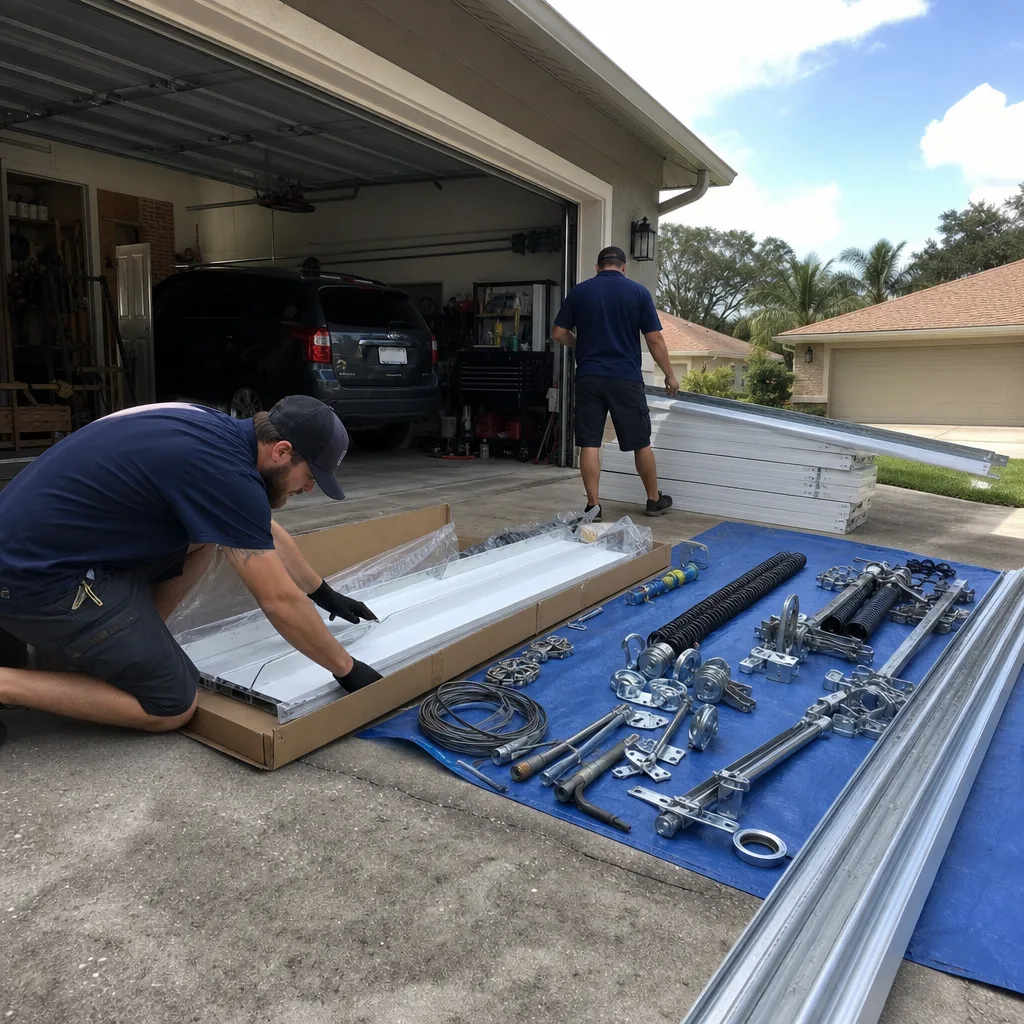
Everything in this guide can be done with tools most Lakeland homeowners already own, with two additions. Here’s the complete list, with costs, so you can budget the year in advance.
- UV-resistant silicone spray, one can: $12 to $20. Buy at any Lakeland auto parts store or hardware store. Not WD-40, not general-purpose lubricant - those leave a residue that attracts dust. Silicone is the correct chemistry for rubber seals.
- White lithium grease, one tube: $6 to $10. For roller stems only, never the track channels.
- Clean dry rags: free, if you have worn-out towels.
- Plastic scraper or putty knife: $4, for lifting pollen paste out of tracks.
- 7/16-inch socket and ratchet: $10 if you don’t own one.
- Masking tape: for marking gaps during the summer seal check.
- Level, 2-foot: $10, for checking slab flatness under the door.
- Phone camera: you already own it, and the photo record matters. Before any work and after any work, take the photo. The documentation is the paper trail that tells you what changed.
Total cost for a year of preventive materials: $45 to $85. The single highest-cost failure a homeowner can prevent with this list is a torsion spring replacement, which runs $180 to $340 in Lakeland, depending on spring size and door weight. For a full breakdown of what garage door work costs in this market, see our Garage Door Cost Breakdown: The Lakeland Homeowner’s Reference for 2026. The single most common failure we see among Lakeland homeowners who skip this maintenance is a track that comes loose during a storm event and takes the door, the rollers, and sometimes the panel sections with it. That repair starts at $450 and goes up from there. The math favors the maintenance.
For homeowners in the Lakeland neighborhoods we serve daily - Dixieland, Lake Morton, Lake Hollingsworth, Beacon Hill, and the newer subdivisions north of I-4 - the difference between a garage door that fails during hurricane season and one that doesn’t is usually something spotted in January or May. The work in this guide, done on schedule, is what makes that difference. For everything else, Servo Garage Doors Lakeland is our home page, and our phone number is (863) 656-0858. When you call, a real person answers, day or night, on holidays too, and we’ll send a background-checked, uniformed technician with a named arrival time and an on-the-way text. We don’t do callback windows.
Common Mistakes to Avoid
- Greasing the track channels. This is the number-one mistake we see in Lakeland garages, and it creates the pollen paste that then grinds down rollers and tripping openers. The track channel stays dry; the roller stem takes the grease.
- Waiting until November to “winterize.” By November, the dry window is gone, the hurricane season is ending, and the work you needed to do in January and May didn’t get done. Follow the calendar, not the national hardware-store flyer.
- Using WD-40 on weather seals. WD-40 is a penetrating oil, and on rubber, it accelerates drying and cracking in a matter of months under Florida sun. UV-resistant silicone is the correct chemistry, and nothing else from the can aisle will do.
- Adjusting the force dial before cleaning the door. The force dial exists to tune the opener’s safety reversal; it doesn’t fix the cause of drag. Clean the tracks and rollers first, then rerun the door, then consider the force setting if the problem persists.
- Ignoring a small gap under the bottom seal. In Lakeland, a 1/8-inch gap becomes a wet garage floor the first time it rains in the summer. Then it becomes rust, mold, and a pest entry point. Seal the gap in January, not after the first storm.
- Checking hardware after the first hurricane warning. The inspection needs to happen before the wind arrives, not after the forecast. By mid-May, the daily wind events have already started; the work is due now, not when the watch is issued.
- Keeping no record of maintenance. The homeowner who can show a date-stamped photo of the work they did and a receipt for the seal they bought is the homeowner who knows what’s original, what’s aging, and what’s been done. Documentation is not paperwork for its own sake; it’s how you catch a problem early next year, and it’s how a pro sees your door with different eyes.
When to Call a Professional
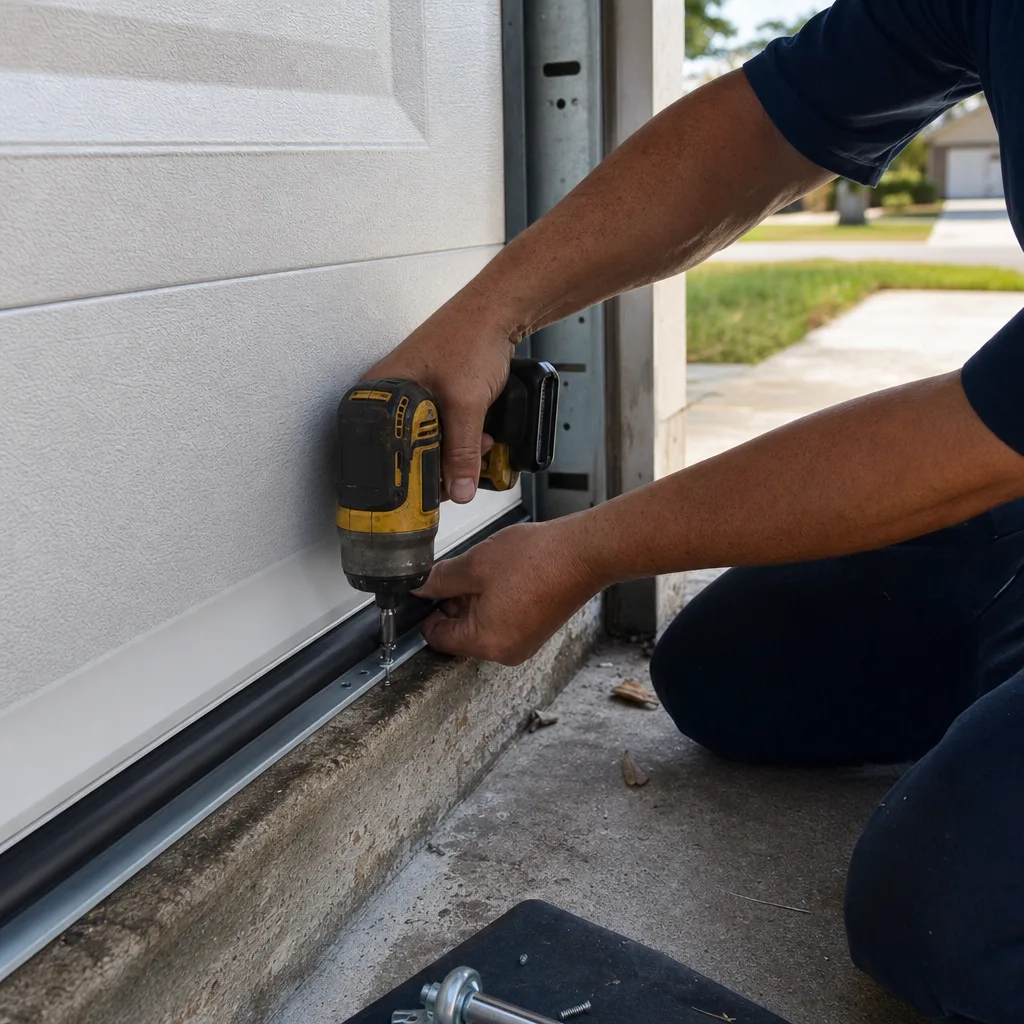
Call a professional when the problem involves spring tension, cables under load, or a component that has failed in a way you can’t fully see. Specifically: a cable that shows broken wire strands, a torsion spring that has snapped or is showing a visible gap in its coils, a track that has pulled away from the wall, a bottom bracket that has shifted, any door that jumps or binds when moved, or an opener that repeatedly trips its thermal cutout after the tracks are clean. It’s also fair to call when you’ve done the work in this guide, found something that doesn’t match what’s described, and don’t want to guess. That’s a technician’s job, not a homeowner’s. For more guides & resources, visit our blog. We are state-licensed, insured and bonded, and our technicians walk every job with a photo record and a written scope before anything is touched. Servo Garage Doors Lakeland offers free estimates in Lakeland - call (863) 656-0858.
Frequently Asked Questions
Twice a year: once in January when you apply UV-resistant silicone to the seals, and once in March or April when you clean pollen out of the tracks and re-lubricate roller stems with white lithium grease. Lubricating more often than that adds nothing in Lakeland’s climate, and using the wrong product on the track channels actively creates the paste that damages rollers.
Yes. The wind loads that loosen track hardware and shift bottom brackets arrive with the outer bands of distant storms, and the daily afternoon thunderstorms we get all summer are enough to expose a structural weakness that has been developing since spring. The pre-June inspection is not about surviving a direct hurricane hit; it’s about catching the small failures before a moderate wind event turns them into big ones.
For a homeowner doing the work themselves, $35 to $85 in materials covers a full year: one can of silicone, one tube of lithium grease, a scraper, masking tape, and a level. If you hire the work out, a Lakeland garage door company will typically charge $75 to $150 for a seasonal inspection and tune-up. We provide a free second opinion on any written estimate from another company - bring the paperwork, and you’ll get a flat written price with the same photo-record standard we’ve used on every job since 2015.
Yes, if the seal itself is the problem and the door remains balanced when you remove it. The seal slides out of the bottom retainer channel, and a new one slides in. You’ll need a screwdriver and about 30 minutes. If the retainer is bent, rusted, or comes loose from the panel while you’re working, stop; that’s a door-bottom repair that involves lifting the panel and should be handled by a pro who can photograph the failed part before quoting the fix.
That’s usually the thermal overload cutout engaging, and it happens because the operator is running hotter than it should - either because the garage itself is over 110°F or because the door is dragging and raising motor current. The likely cause in Lakeland is pollen paste in the tracks or a roller that’s binding. Clean the tracks and rollers, then run the door through a cycle to see if the problem clears. If it still cuts out, the issue may be the logic board, and that’s a replacement decision best made with a diagnostic reading in hand.
Push on the track with your hand at the midpoint between the lag screws, first on the vertical track, then on the horizontal track. If the track moves against the wall or the ceiling, the fastening has worked loose and wind load will make it worse. A track that moves visibly is a call-to-action. A track that is solid but shows rust bloom around a lag screw is also a call-to-action, because the rust indicates the screw has been cycling in and out of the hole; the next step is pull-out, not corrosion.
Call (863) 656-0858 for a free estimate or a second opinion on any written quote.
The Bottom Line
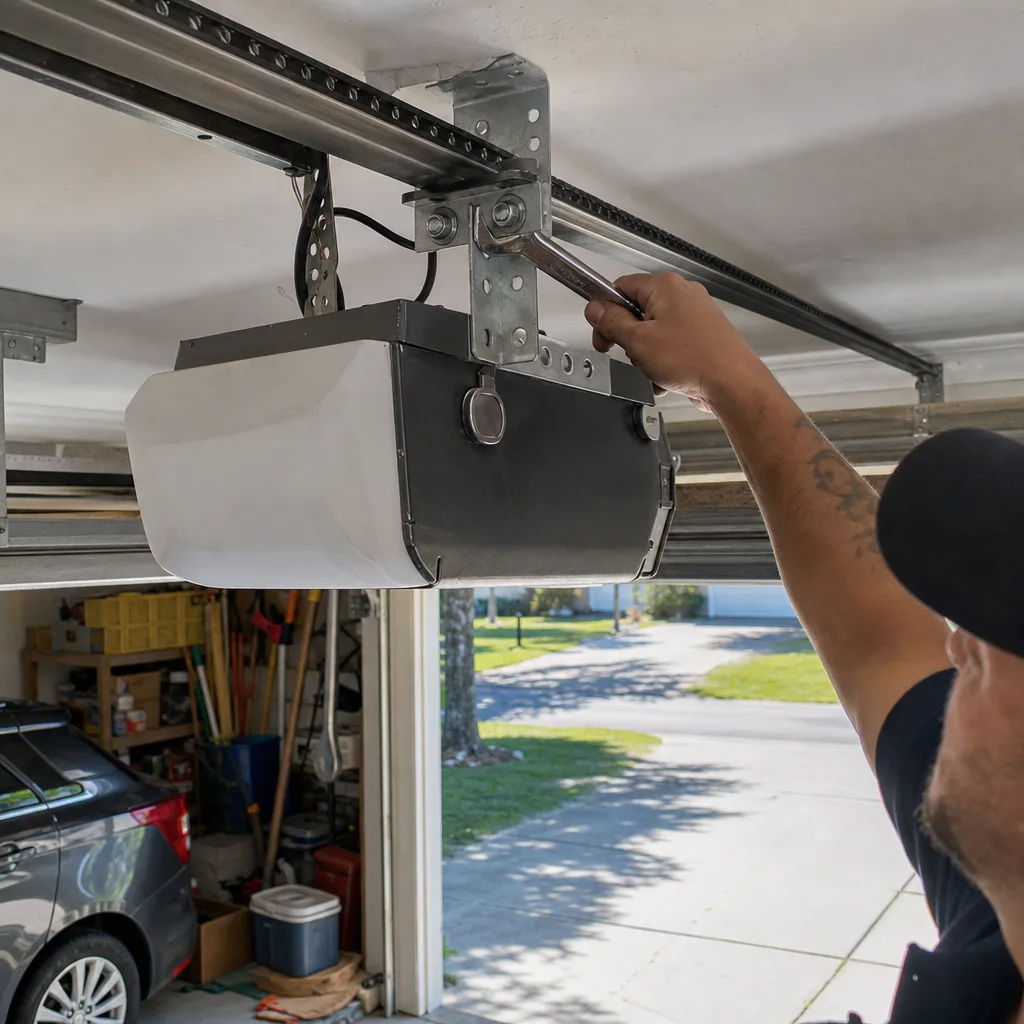
Lakeland’s climate is the real maintenance calendar, not the four-season template from the national hardware chains. January is the dry month for treating seals; February through April is the pollen window for