
Last updated September 20, 2026
Full 25-point door and opener safety check with every visit - springs, cables, rollers, tracks, and your LiftMaster or Chamberlain opener included
You get a price before we start. It does not change when the truck arrives.
 Before
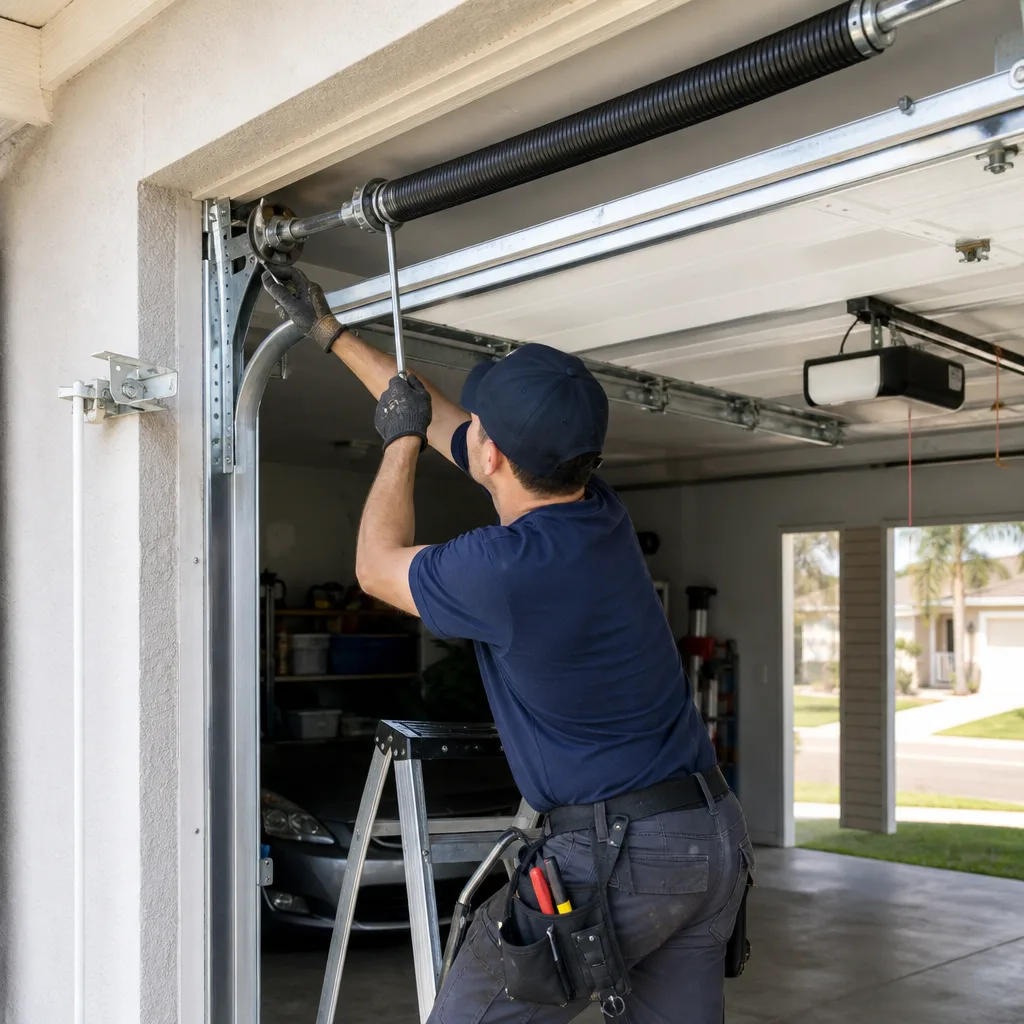 After
After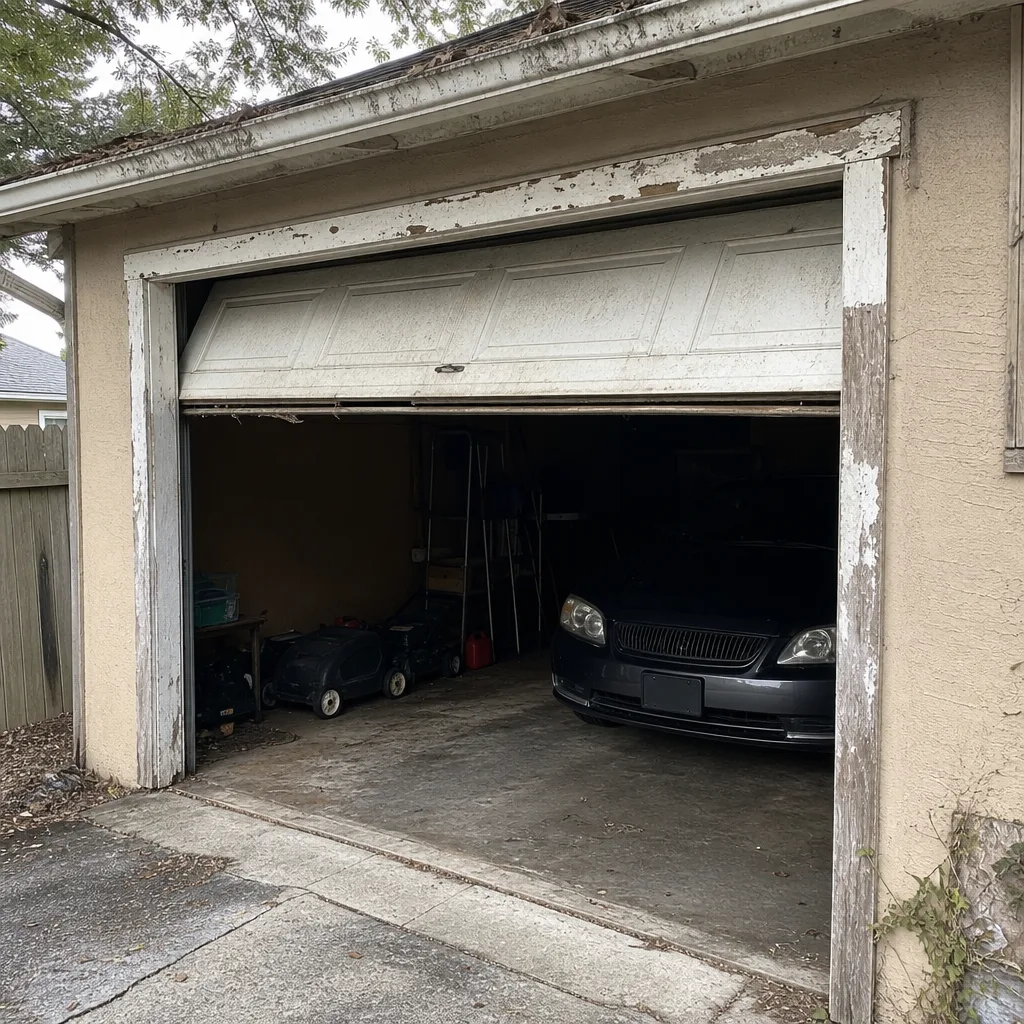 Before
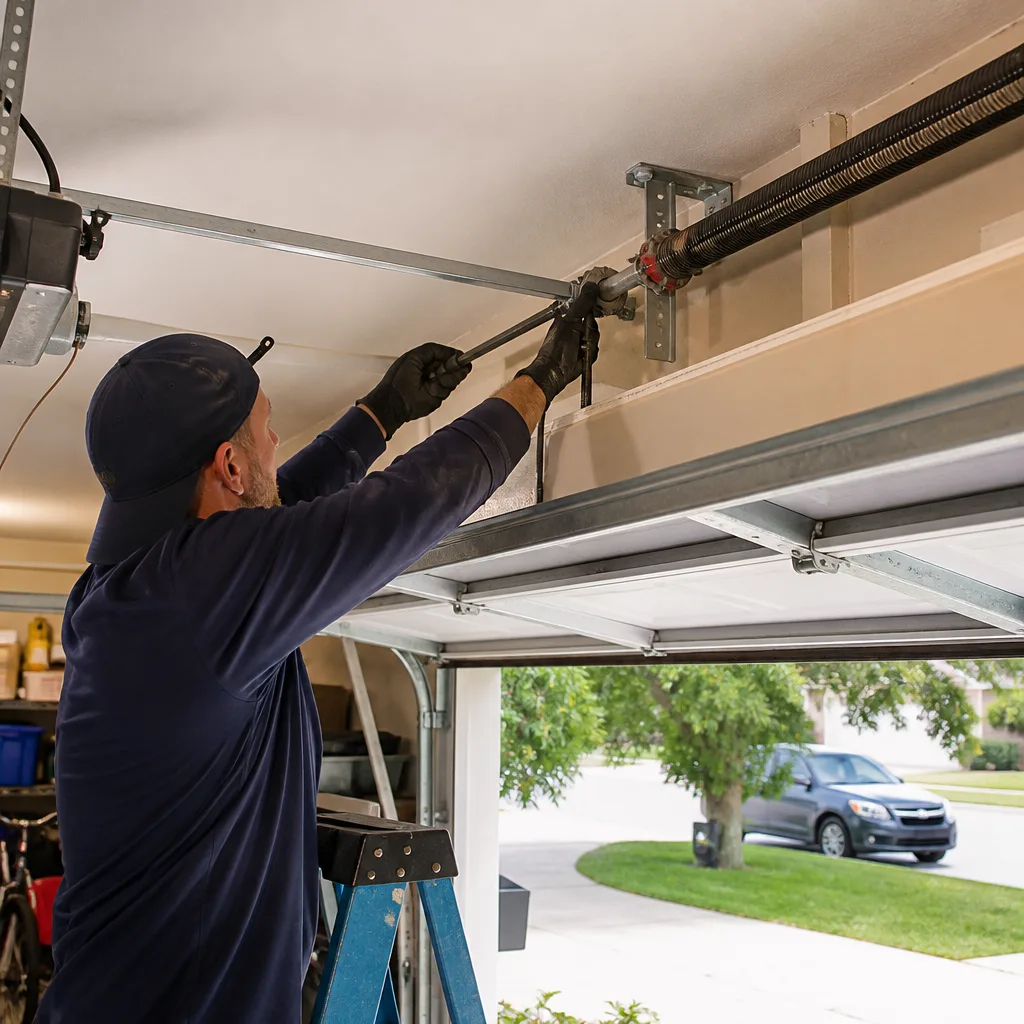 After
After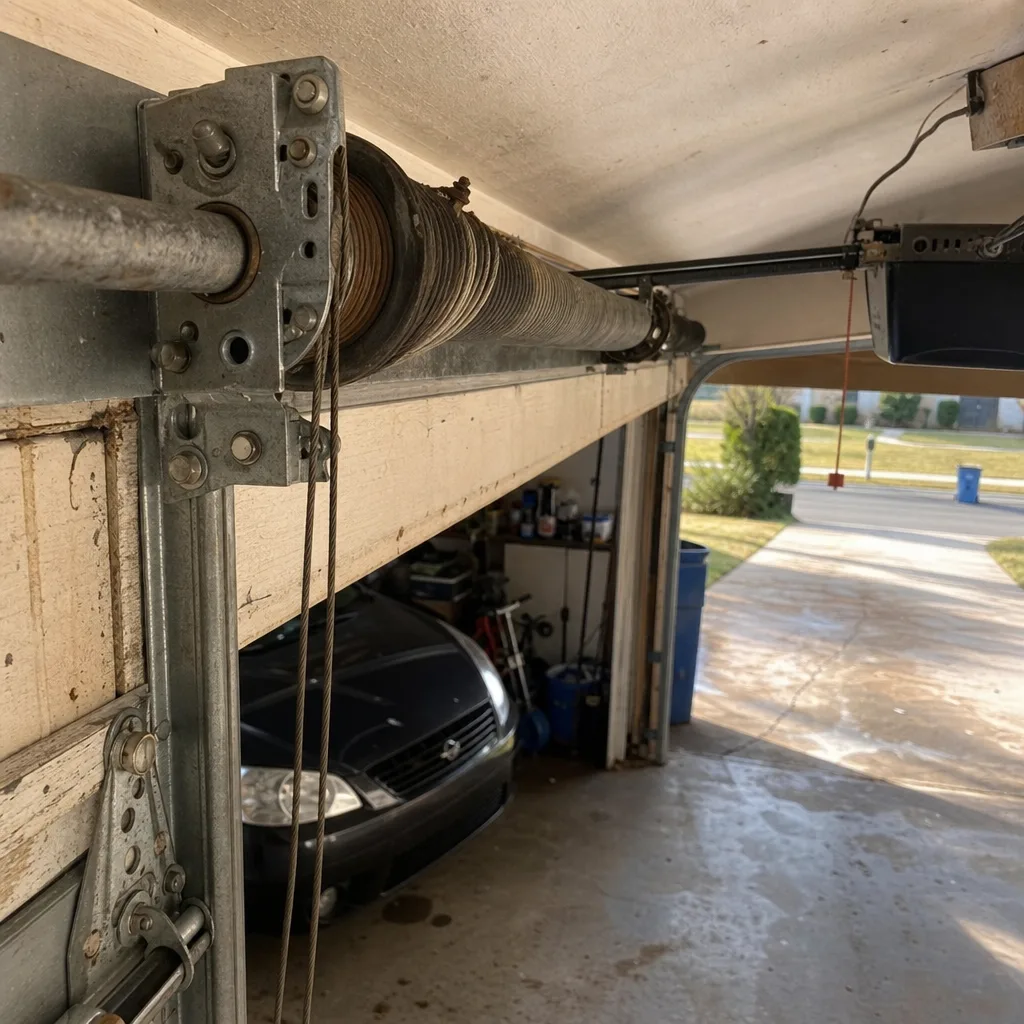 Before
 After
AfterDIY vs Professional Garage Door: The Lakeland Homeowner’s Decision Guide
A garage door weighs between 130 and 400 pounds depending on the material, and the torsion spring that counterbalances it holds enough stored energy to send a metal winding bar through drywall. Most Lakeland homeowners never think about that math until something breaks on a Tuesday morning when the car is trapped inside. This guide walks through which garage door repairs are genuinely safe to do yourself, which ones put you at real risk, what Florida law says about the distinction, and what each path actually costs in Lakeland - see our Garage Door Cost Breakdown: The Lakeland Homeowner’s Reference for 2026 for deeper numbers. We’ve been repairing garage doors here since 2015, and the DIY-versus-professional question is one we get every single week.
Quick Answer
Garage door bottom seal replacement, weather stripping, keypad programming, and simple roller swaps in an open track are reasonable DIY jobs for a careful Lakeland homeowner. Torsion springs, cables, bottom brackets, and anything involving the opener’s electrical components should be handled by a licensed technician, not because the work is intellectually difficult but because a torsion spring under tension releases without warning and can cause a life-altering injury. The dividing line is stored energy, not skill level.
Table of Contents
- The Rule of Stored Energy: How to Judge Any Garage Door Repair
- The DIY-Safe List: Jobs a Careful Homeowner Can Handle
- Torsion Springs: The Physics That Makes DIY Replacement Dangerous
- Florida Licensing Law: What Garage Door Work Requires a Contractor
- DIY vs Professional: The Real Cost Comparison in Lakeland
- Sourcing Correct Parts: How to Use Serial Numbers and Manufacturer Docs
- Homeowner’s Insurance: What DIY Repair Does to Your Coverage
- Common Mistakes to Avoid
- When to Call a Professional
- Frequently Asked Questions
- The Bottom Line
BeforeAfterThe Rule of Stored Energy: How to Judge Any Garage Door Repair
Every garage door repair falls into one of two buckets: jobs that involve stored energy, and jobs that don’t. The distinction matters more than your mechanical ability, more than the quality of your tools, more than how many YouTube tutorials you’ve watched. A torsion spring wound to working tension on a standard 7-foot residential door stores roughly 150 to 200 foot-pounds of torque. That’s enough force to break a wrist, fracture an orbital bone, or worse if the winding bar slips. The spring doesn’t care how careful you are. It only cares whether the tension is released in a controlled way.
Here’s the rule we use with every customer in Lakeland: if the component is under spring tension, cable tension, or line voltage, it’s a professional job. Period.
This isn’t gatekeeping. We replace bottom seals for homeowners who don’t want to deal with the mess, and we’ll tell you during the visit that you could have done it yourself with a $28 part and a utility knife. What we won’t do is pretend a torsion spring replacement is in the same category as a rubber flap along the floor. The two jobs look adjacent in a parts diagram and a garage. They are nothing alike in consequence.
Components Under Stored Energy (Professional Work)
- Torsion springs: wound under 150-200 foot-pounds of torque on a standard door
- Extension springs: stretched under tension that increases as the door closes
- Cables: under load whenever the door is up or partially open
- Bottom brackets: anchor the cables; when they fail, the cable becomes a projectile risk
- Opener electrical components: logic boards, limit switches, capacitor wiring, and any line-voltage work
Components with No Stored Energy (DIY-Safe)
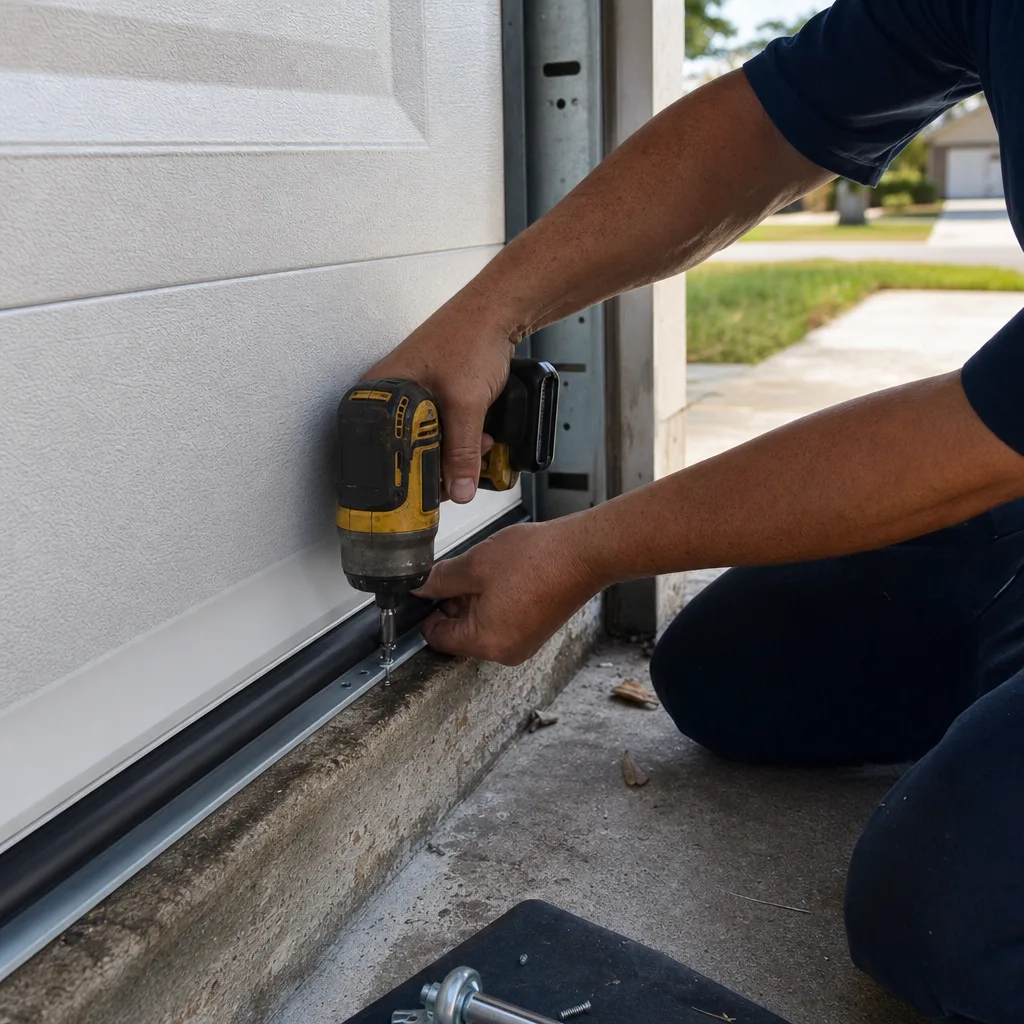
- Bottom seal: a rubber strip held in a track along the door’s lower edge
- Weather stripping: vinyl strips around the door perimeter
- Rollers in open track sections: only when the section sits in a vertical track and the door is fully closed with tension off
- Keypad and remote programming: instructions in the opener manual
- Battery backup replacement: on openers with an accessible battery compartment
In North Lakeland’s older homes, we regularly see doors from the 1990s and early 2000s where the torsion spring has never been measured or documented. The spring sits there, rusted, cycling daily, holding the same energy it was wound with on installation day. That’s not a component to improvise around. The Garage Door Repair in Lakeland side of our work starts with identifying exactly where that energy lives and whether it’s been compromised.
The DIY-Safe List: Jobs a Careful Homeowner Can Handle
Some garage door maintenance is genuinely approachable, and being honest about that is part of how we operate. If you’re in South Lakeland near Lake Hollingsworth or out in Kathleen, these are the repairs you can reasonably tackle on a Saturday morning without special tools or safety equipment - check our Garage Door Repair Maintenance Checklist for Lakeland Homeowners for a full rundown.
1. Bottom Seal Replacement
The bottom seal is the rubber strip along the bottom edge of the door that keeps water, pests, and leaves out of the garage. It wears out from friction against the concrete and from Florida’s heat, which hardens rubber faster than northern climates. Replacement parts run $25 to $60 for a standard 16-foot door. The job takes about 20 minutes: slide the old seal out of the retainer channel, slide the new one in, trim the excess. No springs. No cables. No risk.
2. Weather Stripping Replacement
The vinyl stripping around the sides and top of the door opening degrades from sun exposure, and Lakeland gets roughly 240 sunny days a year. When the stripping cracks, you get drafts, bugs, and higher cooling bills since your garage shares wall space with your conditioned house. Replacement stripping costs $15 to $40 per side. It pulls out of the track and presses back in. This is a 15-minute job.
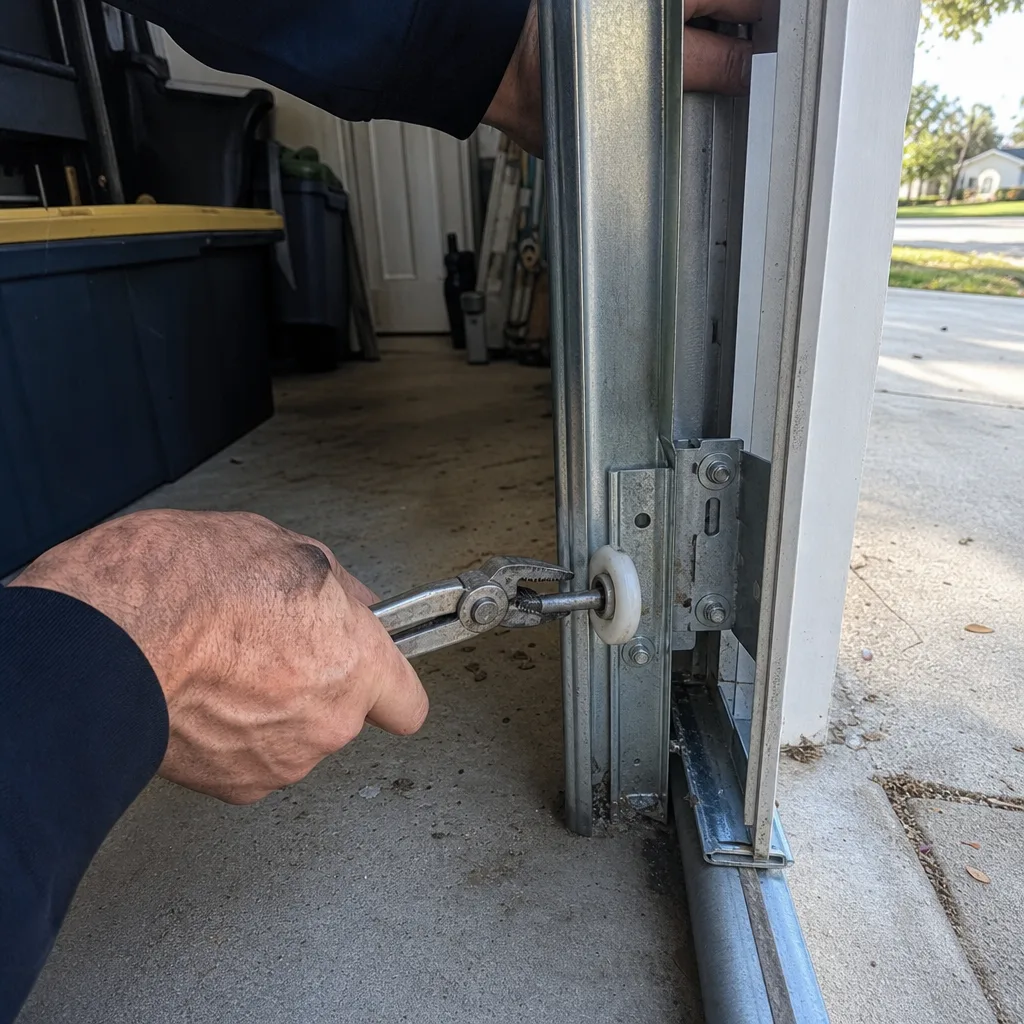
3. Roller Swap in an Open Vertical Track
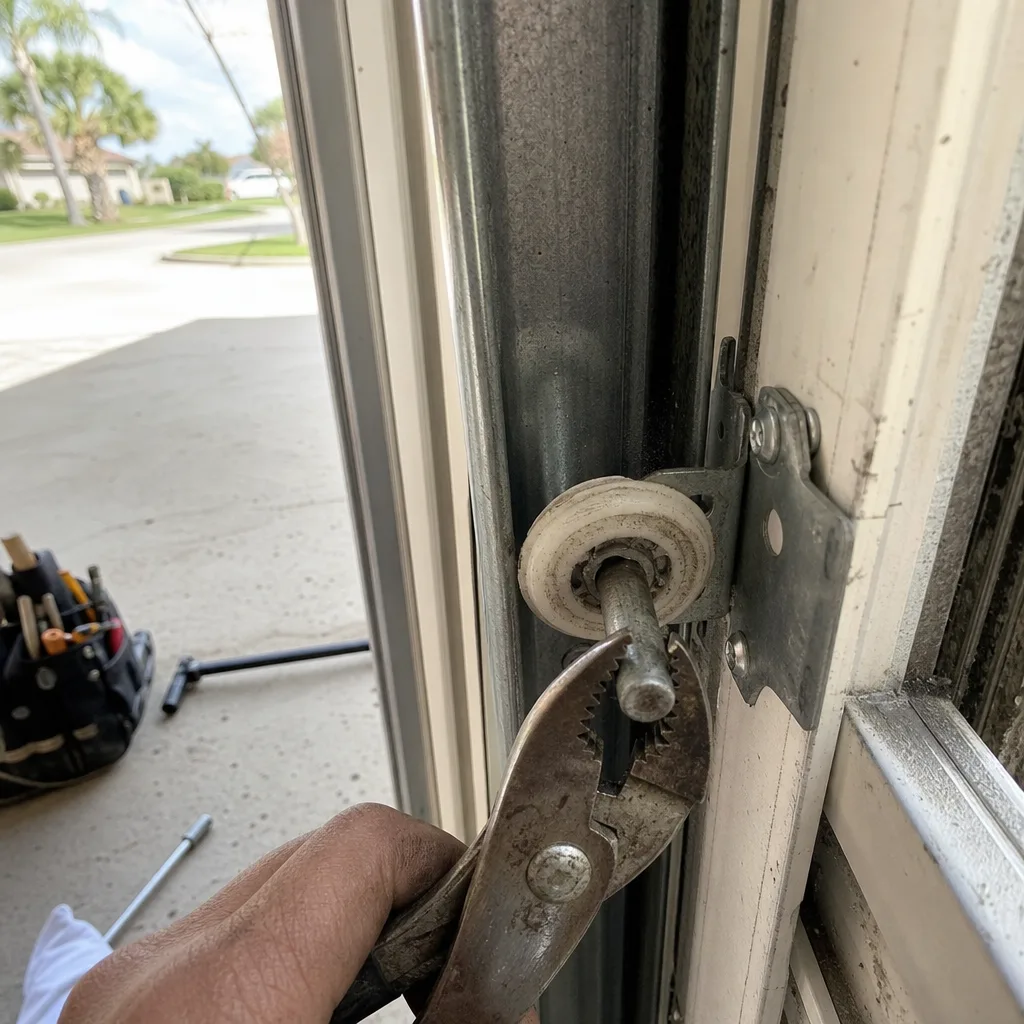
This one needs a caveat. If a roller is worn and squealing, you can sometimes replace it yourself when the door is fully closed and the roller sits in a vertical track with no load on it. You pop the hinge, swap the roller, reassemble. But if the roller is in a horizontal track, in the curve, or the door is up, the component is under tension from the door’s weight and you should not touch it. If you’re not certain how to read the load path, don’t guess.
4. Keypad and Remote Programming
Every major brand, including LiftMaster and Craftsman, publishes the programming sequence in the opener manual. Most involve pressing a learn button on the opener head and entering a code on the keypad or remote. The entire process takes under 10 minutes. If you’ve lost the manual, the brand’s website hosts PDF copies you can search by model number, or browse our more guides & resources for additional help.
5. Battery Backup Replacement
If your opener has a battery backup unit, usually a gray box mounted near the opener head, the battery inside is a consumable that lasts three to five years. Replacement batteries for LiftMaster and Chamberlain units run $40 to $90 depending on the model. The swap is unplug, open the cover, disconnect two terminals, reverse the process. No line voltage is involved.
Here’s the thing about the DIY-safe list. These are the jobs where the professional invoice reflects labor and truck roll more than parts, and doing them yourself genuinely saves money. It’s also where a botched repair costs little to correct. The asymmetry is the point: DIY-safe means the downside of a mistake is a trip back to the hardware store, not a hospital.
If you ever want a professional to do the DIY-safe jobs anyway, we quote them with a flat written price before starting, the same as every other job. No plumbing-style mystery billing. The Garage Door Installation in Lakeland side of what we do also covers full door replacement when a door has reached the point where sealing and weather stripping are no longer enough.
Torsion Springs: The Physics That Makes DIY Replacement Dangerous
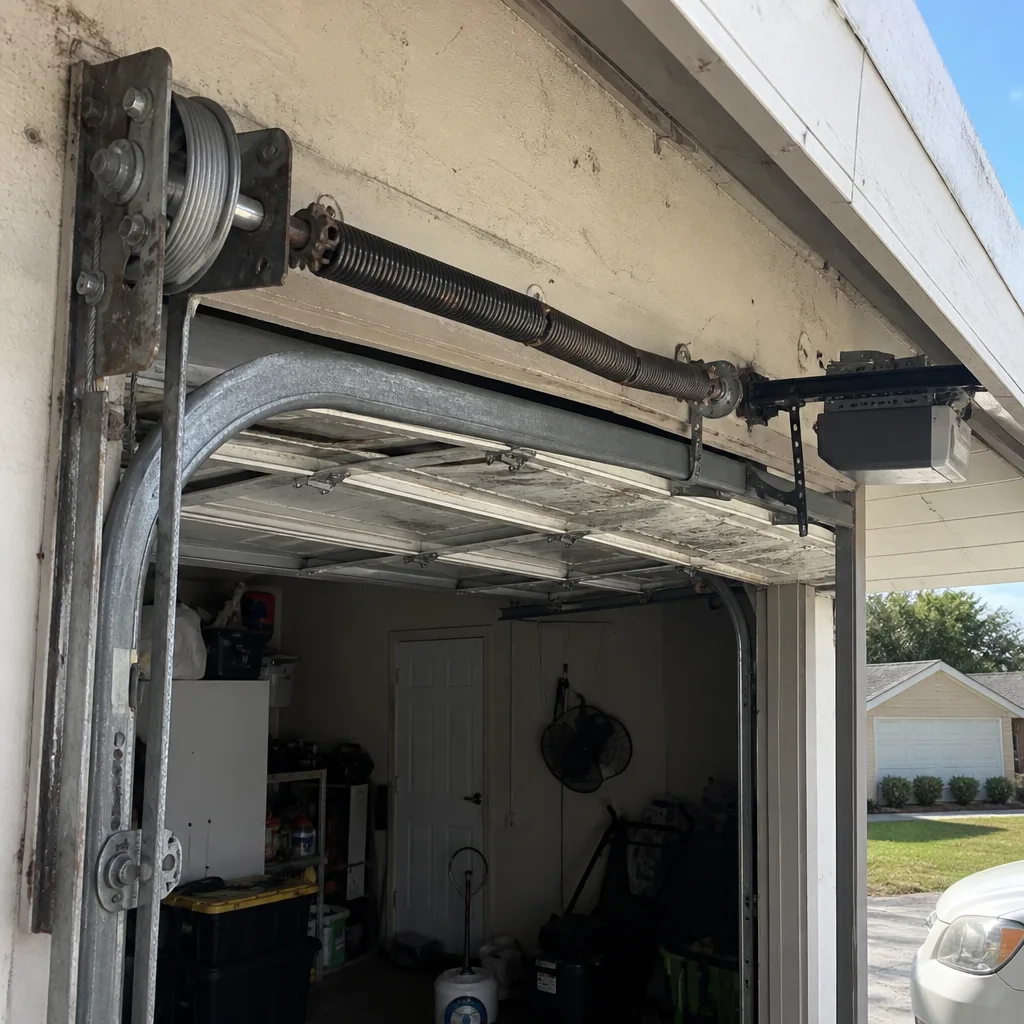
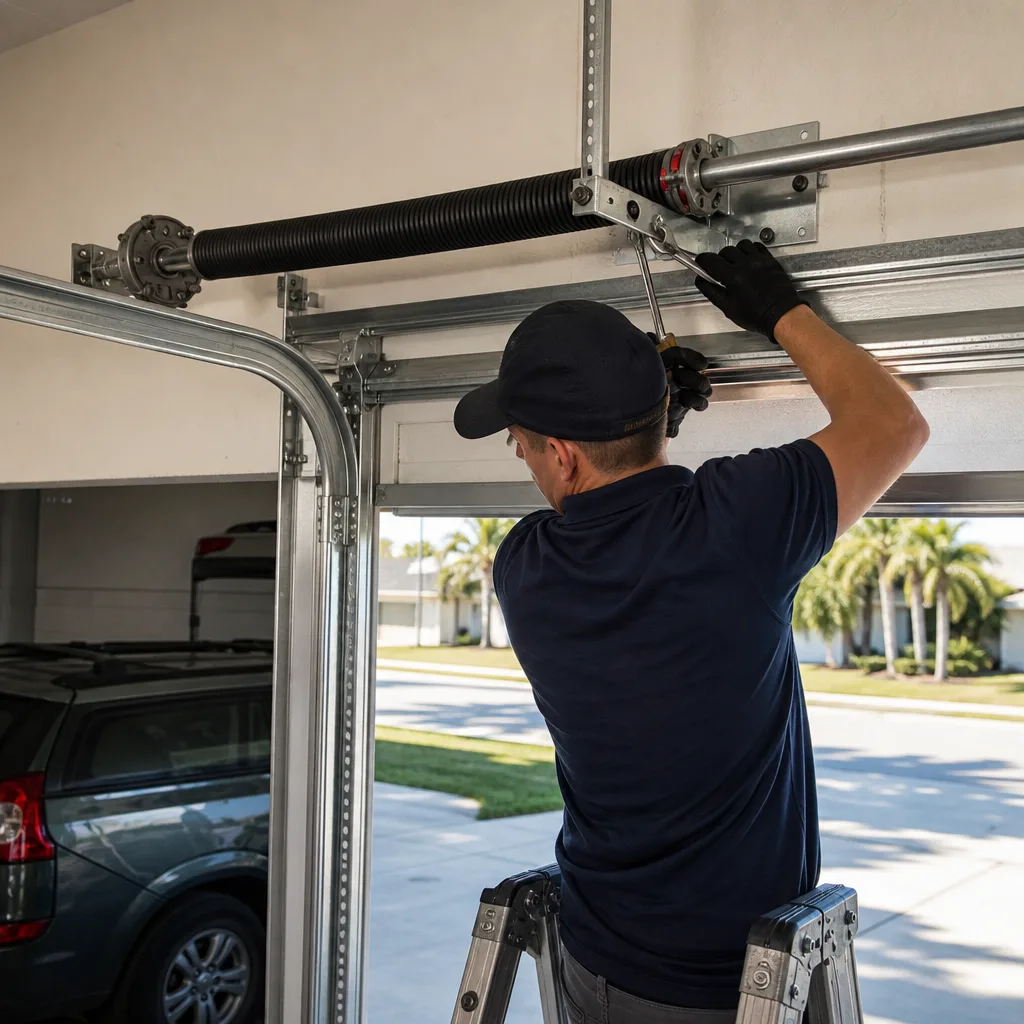
Let’s talk about what a torsion spring actually is, because understanding the mechanism is the best argument for respecting it. A torsion spring is a thick coil of hardened steel mounted horizontally above the closed door. During installation, a technician winds the spring to a specified number of turns, which stores rotational energy in the coil. That stored energy counterbalances the door’s weight, so the opener only lifts a fraction of the actual load. On a standard 7-foot door, a properly wound spring stores roughly 150 to 200 foot-pounds of torque. That means when the spring is at rest, it wants to unwind with enough force to lift 150 to 200 pounds at a one-foot lever arm.
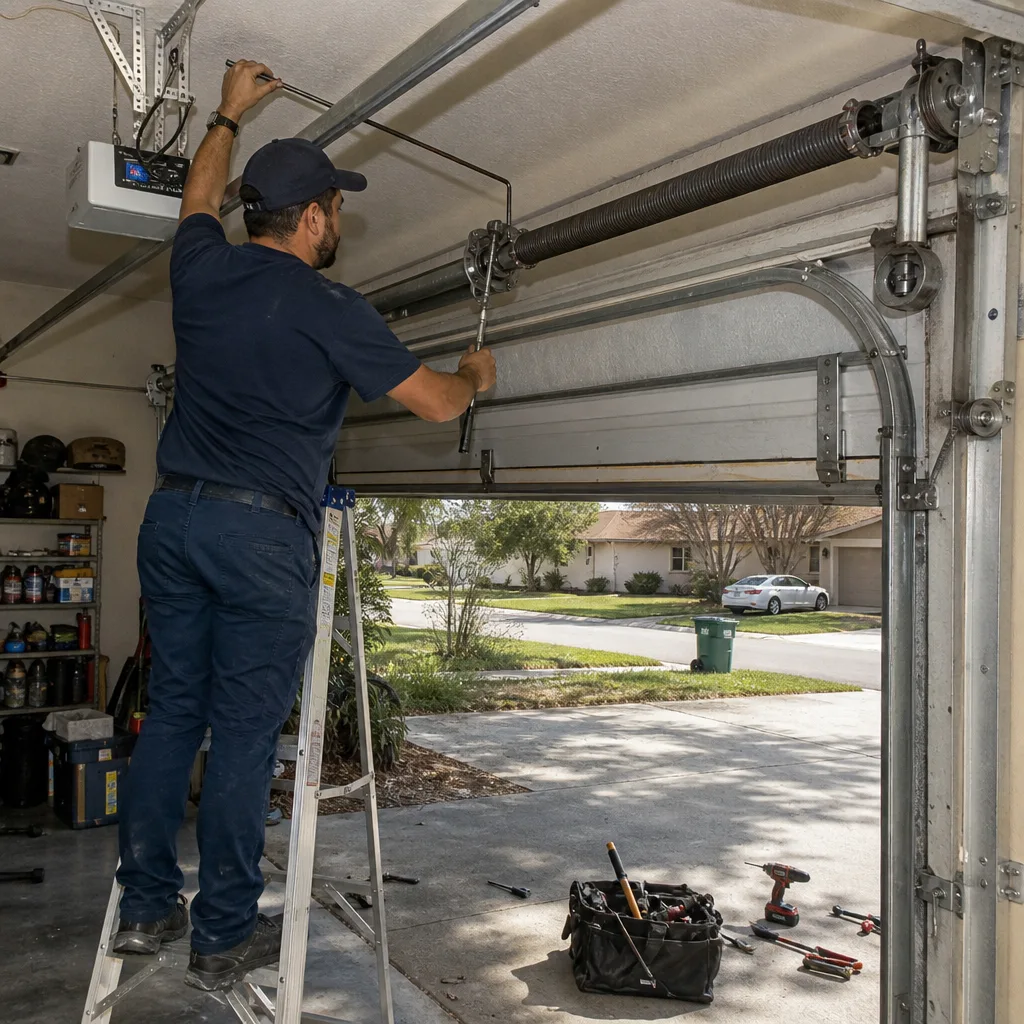
When a spring breaks, it releases that energy instantly. The break usually happens at the coil, and the released torque sends the two halves spinning in opposite directions. In our 10 years of service across Lakeland, we’ve seen broken torsion springs snap a drywall ceiling, dent a car hood, and embed a piece of coil in the garage wall. The spring itself becomes a projectile, but the real danger in DIY repair comes from the tension that’s still stored in a spring that hasn’t broken yet.
Replacing a torsion spring means transferring that stored energy from the old spring to the winding bars you’re holding. You insert two 18-inch steel bars into the winding cone and rotate the spring a quarter-turn at a time, building tension. If a bar slips out of the cone, the spring unwinds at full speed with the bar still attached to your hand. There is no way to make this safe for a homeowner working with improvised tools. The bars used by professionals are hardened steel, sized to the cone’s socket, designed specifically for this task. A screwdriver or Allen wrench is not a substitute. It will bend, slip, and turn a controlled wind into a violent release.
The comparison we use with customers: replacing a bottom seal is like changing a light bulb. Replacing a torsion spring is like defusing ordnance from a ladder while holding the detonator pin between your fingers. The skill isn’t the issue. The consequence of a slip is the issue.
Why the Internet Makes It Look Easier Than It Is
Search “torsion spring replacement” on any video platform and you’ll find a man in a garage doing it in 12 minutes with a pair of winding bars he bought online. What the video doesn’t show is the spring dimension calculation, the door weight measurement, the cycle rating verification, or the experience of handling a bar that starts to slip. The video also doesn’t show the aftermath of the attempts that went wrong, because those homeowners don’t upload the footage.
We’ve never met a Lakeland homeowner who called us after a successful DIY spring replacement. We’ve met several who called after an unsuccessful one, with a garage door hanging crooked, a cable off the drum, and a spring half-wound. Correcting a botched spring installation costs more than the original replacement would have, because now we’re diagnosing what was done wrong before we can do it right. The Garage Door Opener Repair & Installation in Lakeland work is straightforward when the door is balanced and the spring is wound correctly. When it isn’t, the job gets complicated fast.
Florida Licensing Law: What Garage Door Work Requires a Contractor
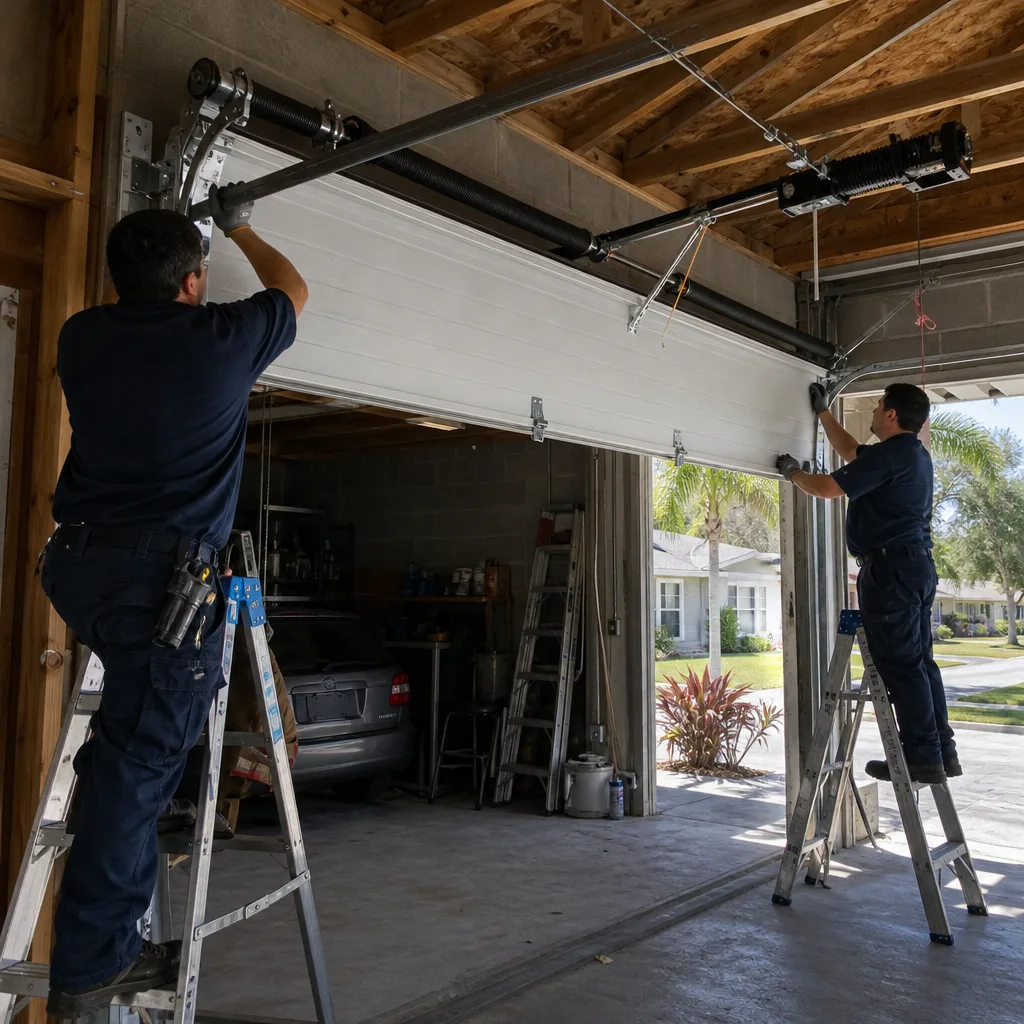
Florida does not have a dedicated garage door contractor license category. Garage door installation and repair falls under the broader specialty structure of Chapter 489 of the Florida Statutes, which governs contractor licensing. Depending on the scope of the work, a garage door installation may be performed by a licensed general contractor, a licensed residential contractor, or a specialty contractor with a local license. What matters for the homeowner is what happens when work is done without any license at all.
When you hire an unlicensed person to perform work, Florida law treats you as the employer. That means you are liable for injuries the person sustains on your property. If an unlicensed handyman falls from a ladder while replacing your torsion spring and is seriously injured, your homeowner’s insurance may not cover the claim because the work was performed by an unlicensed individual. The liability question doesn’t apply to DIY work in the same way, but it applies directly to the homeowner who hires a “guy on Craigslist” to save $100.
There’s also a statutory issue with permits. In Lakeland and Polk County, a garage door replacement on an existing opening typically does not require a building permit. But structural modifications, widening an opening, or installing a new opening does require permitting through the City of Lakeland or Polk County Building Division. If you’re doing DIY work that crosses into structural territory, you’re now operating without a permit, which creates its own insurance and resale consequences.
What This Means for the DIY Decision
The legal dividing line is practical. A bottom seal, weather stripping, or keypad programming involves no structural change, no electrical work, and no permitting question. You can do those jobs without any legal exposure. A torsion spring replacement, cable repair, or opener electrical work crosses into territory where the stakes shift from inconvenience to liability. The spring failure that injures a technician in your garage is a legal matter. The spring failure that injures you because you were winding it with an improvised tool is a medical matter. Neither one is a savings strategy.
Servo Garage Doors Lakeland is independently owned and operated under The Haven Standard, and the local business holds its own license and insurance. When we send a technician to your home in Lakeland, that technician is background-checked and uniformed, and the license number is on the page, not buried in fine print. Clause 1 of The Haven Standard means the price is written before any work starts. You’ll know what leaving looks like before we arrive.
DIY vs Professional: The Real Cost Comparison in Lakeland
The cost argument for DIY depends entirely on which component you’re dealing with. Here’s an honest breakdown using current Lakeland market rates for parts and professional service.
Where DIY Saves Meaningful Money
- Bottom seal replacement: DIY parts cost $25 to $60. Professional replacement in Lakeland runs $90 to $150 including the service call. You save $60 to $90 doing it yourself.
- Weather stripping: DIY parts cost $15 to $40 per side. Professional replacement runs $80 to $140. You save $50 to $100.
- Keypad programming: DIY cost is $0 if you have the manual. Professional programming during a service call adds $50 to $75 to the visit. You save that entire amount.
- Battery backup replacement: DIY parts cost $40 to $90. Professional replacement runs $120 to $180. You save $60 to $100.
Where DIY Creates a Larger Professional Invoice
- Torsion spring replacement: parts for a pair of springs cost $80 to $150 online. But if the winding goes wrong, you now have a door with mismatched tension, cables off the drums, and a potential safety hazard. Replacing both springs and resetting the door correctly in Lakeland typically runs $250 to $450. The botched DIY attempt that damages the winding cone or bends the shaft pushes that toward $400 to $600 because now the technician is replacing components that were fine before the attempt.
- Cable replacement: parts online cost $20 to $40. But cables run under load, and a cable that snaps during a DIY attempt can take out the bottom bracket or damage the track. Professional cable replacement in Lakeland runs $150 to $220. A botched cable attempt can double that.
- Opener logic board replacement: board costs $80 to $150 online. But misdiagnosing the board when the problem is actually the limit switch or the trolley carriage means you’ve spent money on the wrong part and still need a technician to find the real fault. Diagnostic visits start at $85 to $120 in Lakeland, and that’s before any repair.
Here’s the pattern. DIY saves money on components that carry no tension and no voltage. DIY costs multiples of the professional rate on components where a mistake cascades. The Florida climate makes this math more punishing. Garage door components in Lakeland degrade faster due to humidity, summer heat, and the thermal cycling of a garage that hits 110 degrees in August and 50 degrees in January. A door that’s been cycling in that environment for 10 years has wear on every load-bearing component, not just the one that failed. The professional’s job includes finding the neighboring failures before they happen. The DIY version finds them when they break.
Every job we do follows the same rule from Clause 1 of The Haven Standard: a flat, written price and written scope are delivered before any work starts. There’s no “we’ll see once we get in there” pricing. The number you see is the number you pay, and the photo record you receive at the end shows exactly what was found and what was done. If a competing company gives you a written estimate you want compared, bring the paperwork. The Free Second Opinion offer applies to any written estimate from another company, no coupon required.
Sourcing Correct Parts: How to Use Serial Numbers and Manufacturer Docs
If you’ve decided to handle a DIY-safe job, the quality of the outcome depends on getting the right part the first time. Here’s the process for doing that without guessing.
- Find the serial number before you order anything. For the door itself, the serial number is usually on a sticker on the interior side of the door panel, often near the bottom or in the top section. For a LiftMaster or Craftsman opener, the serial number is on the motor head, printed on a label with the model number. For a spring, the dimensions matter more than the serial, and we’ll get to that in a moment.
- Look up the door manufacturer’s parts documentation. Brands like Wayne Dalton and Raynor publish online parts catalogs organized by door model. When you have the model number from the serial plate, you can pinpoint the exact bottom seal profile and weather stripping the factory installed. Garage door seals are not universal; a Wayne Dalton 9100 uses a different profile than an Amarr Classica. A generic seal bought from a home center will fit neither properly.
- Use the opener model number, not the brand name alone. LiftMaster has made hundreds of opener models. The model number on the label tells you exactly which battery, logic board, or keypad pairs with your unit. Searching “LiftMaster battery” returns wrong results. Searching “LiftMaster 8500W battery” returns the correct part.
- For rollers, match the stem length and wheel diameter. Rollers come in a few standard sizes, but garage doors from different eras used different stem lengths. If the door is from the 1990s and you order a modern roller, the stem may be too short to seat in the hinge. Measure the old roller before ordering the new one.
- Check the cycle rating on any spring you buy. Torsion springs are rated in cycles, with standard springs rated at 10,000 cycles and upgraded springs at 25,000 or more. The cycle rating tells you how many open-close cycles the spring is designed to survive. A cheap spring rated at 5,000 cycles will need replacement again in a few years. A spring matched to the door’s weight and usage can last a decade. If you’re having a professional do this, ask what cycle rating they’re quoting. The written scope should say.
Here’s the part that surprises people: the parts markup on a professional repair is often not the expensive part of the invoice. The expensive part is the labor and the liability. When a technician in Lakeland quotes a spring replacement at $300, you’re not paying $180 in parts and $120 in labor. You’re paying for the spring, the winding, the balance check, the safety inspection of every component under load, and the written documentation that says the job was done to a specific standard. The photo record you receive at the end is not a courtesy. It’s the evidence that the work happened as described, and it traces back to the founding rule Servo was built on in 2015: the customer sees the failed part before anyone quotes a replacement. Clause 4 of The Haven Standard makes that rule binding.
Homeowner’s Insurance: What DIY Repair Does to Your Coverage
Most Lakeland homeowners never think about their insurance policy until a claim happens. The answer to whether DIY garage door repair affects your coverage depends on two things: what you did, and what happened because of it.
If you replace a bottom seal or reprogram a keypad and the work fails, the consequence is a wet garage or a door that doesn’t open. That’s not an insurance matter. If you attempt a torsion spring replacement and the spring causes an injury, your homeowner’s insurance may cover the medical costs but the adjuster will ask questions about how the injury happened. Some policies contain exclusions for injuries sustained during maintenance activities that a reasonable person would have delegated to a licensed professional. Whether the exclusion applies depends on your policy language and the adjuster’s judgment, but the fact that it can apply is the point. You don’t want to test it.
The more common insurance issue in Lakeland involves hurricane season and wind mitigation. A garage door that doesn’t seal or latch properly is a wind entry point, and Florida insurance carriers scrutinize garage doors during underwriting and claims. If you’ve done DIY work on the door’s structural components and the door fails during a storm, the carrier may argue the failure resulted from substandard work. The argument might not hold, but you’ll spend time and money fighting it, and the claim delay during hurricane season is its own problem.
The cleanest position is also the simplest. Do the DIY jobs that carry no structural or tension consequence. Hire a licensed professional for the jobs that do. Keep the documentation. Every visit from Servo includes a documented photo record of findings and completed work, and every job closes with a written warranty. That paper trail is what an insurance adjuster asks for, and it’s what most DIY outcomes can’t produce.
Common Mistakes to Avoid
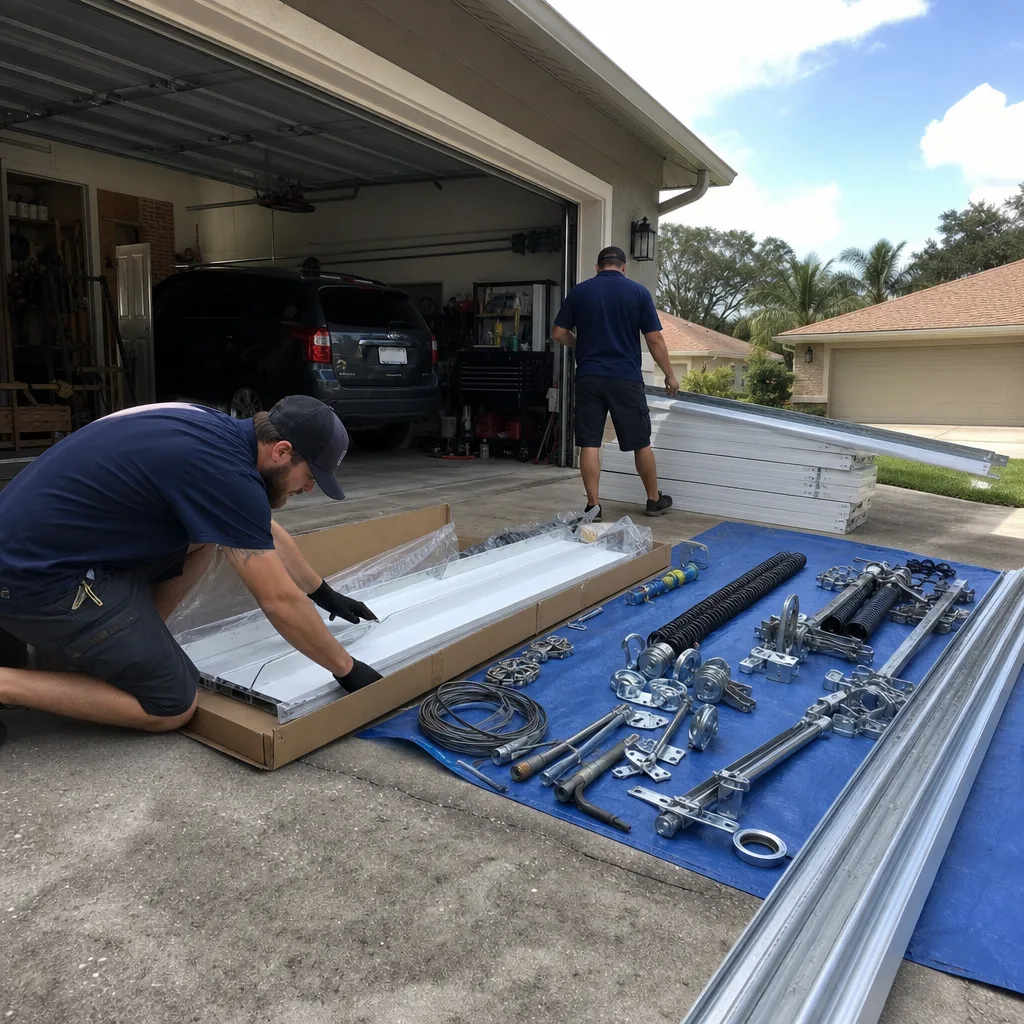
- Reusing winding bars from a previous attempt that were never meant to be winding bars. A handled ratchet extension or a piece of rebar will slip out of the winding cone. We’ve seen the drywall damage in Lakeland homes to prove it.
- Replacing one torsion spring instead of both. When one spring breaks, the other is usually at the same stage of wear. Replacing only the broken one leaves a door that cycles unbalanced, which accelerates wear on the opener and the new spring. A professional replacement in Lakeland always quotes both springs, along with a written explanation of the cycle rating.
- Ordering a universal bottom seal instead of the factory profile. Universal seals leak in Florida’s downpours. The factory profile fits the retaining channel exactly, and the channel dimensions vary across Wayne Dalton, Raynor, and Clopay doors.
- Trying to diagnose the opener logic board without checking the limit switch first. When a LiftMaster or Craftsman opener stops mid-travel, the limit switch is the cheapest and most common cause. Homeowners replace the logic board, the problem persists, and now they own a $120 part that was never the fault.
- Winding a spring without confirming the door’s actual weight. Every torsion spring is matched to the door weight. A steel door from the 1990s weighs more than an insulated aluminum door from 2015. Winding a spring that’s under-rated for the door’s weight means the spring fails early, usually with a loud crack that sounds like a gunshot at 6 a.m.
- Ignoring the permit question on structural changes. Widening an opening, adding a new garage door opening, or modifying the header is structural work. It requires a permit in Polk County, and skipping the permit creates a resale liability you’ll have to disclose.
- Deciding based on the best-case scenario in the video. Every YouTube repair video shows the job going right. The DIY decision is about what happens when it goes wrong. For bottom seals, a wrong outcome costs $30. For torsion springs, a wrong outcome costs a trip to the emergency department.
When to Call a Professional
Call a licensed garage door professional when the component carries spring tension, cable tension, or line voltage. A snapped torsion spring, a frayed cable, a bottom bracket that’s separating from the door, an opener that sparks or trips a breaker, a door that’s come off its tracks. These are not judgment calls. They’re bright lines.
Call when the door makes a noise you can’t place, because that noise is often the spring or cable giving a warning before it fails. Call when the door won’t balance, because a door that drifts when you disconnect the opener is telling you the spring is about to let go. Call when you’re not certain. A diagnostic visit is cheaper than a repair from a fall. Servo Garage Doors Lakeland offers free estimates in Lakeland - call (863) 656-0858. A real person answers, 24/7, including holidays, and the estimate is written, flat, and delivered before any work starts.
Frequently Asked Questions
Replacing both torsion springs on a standard residential door in Lakeland typically runs $250 to $450, including parts, labor, and a balance check. Single-spring replacement is cheaper but usually not recommended because the second spring is at the same wear point. Call (863) 656-0858 for a written, flat-price quote with no obligation - the number you get is the number you pay.
You can, in the sense that the tools are available for purchase. The winding bars transfer the spring’s stored energy to your hands, and if a bar slips from the cone, the spring releases that energy through the bar at full speed. In our experience, the homeowners who ask this question understandably underestimate the torque involved. This is the one repair where we tell customers plainly: the savings are not worth the consequence of a slip.
Florida law doesn’t restrict homeowners from repairing their own property, so a bottom seal, weather stripping, keypad programming, or roller swap are all legal DIY work. The legal exposure comes from hiring an unlicensed person or performing structural modifications without a permit. Hire a licensed contractor for work under tension or voltage, and pull the required permits for structural changes.
Injury coverage depends on your policy’s language and the adjuster’s interpretation. Some policies contain exclusions for self-performed maintenance that a reasonable person would delegate. Damage to the door from a botched DIY repair is almost never covered, because insurance protects against sudden loss, not mistakes you made while working on your own property.
The bottom seal replacement is the most common DIY job we see, and it’s also the most common fix we make for customers who’d rather have it done for them. Florida’s heat and humidity harden the seal material, and a seal that’s been in place for three summers is usually cracked or flat. The replacement is simple, cheap, and genuinely DIY-appropriate.
If the door is uneven when it opens, if it drifts downward when you release the opener, if the cables look frayed, if the spring has a visible gap, or if the opener makes a grinding noise, that’s professional attention. These are warning signs of a load-bearing failure, and the repair belongs on the professional side of the line. Call (863) 656-0858 for an evaluation from a technician who will show you, with photos, exactly what’s failing and why.
The Bottom Line
The garage door DIY decision comes down to one question: does this component store energy that can hurt me? Bottom seals, weather stripping, rollers in an open track, keypads, and battery backups don’t. Torsion springs, extension springs, cables, bottom brackets, and electrical components do. In Lakeland’s climate, garage door components age faster than the national average, and the wear spreads beyond the part that failed first. Do the safe jobs yourself and keep the parts receipt and the model numbers filed where you can find them. Hire a licensed professional for the rest, get the price in writing before the work starts, and keep the documentation. The paper trail is the part of the job you can’t build yourself.
Written by Marcus Deller, Owner at Servo Garage Doors Lakeland, serving Lakeland since 2015. Learn more about our approach on the Servo Garage Doors Lakeland home page.